7 Best AI Agent Builders for Business Workflows
Contents
The best AI agent builder depends on who will build the agent, which systems it must use, and what can happen when it makes a mistake.
A sales team may want agents that research accounts and update HubSpot. A developer may need self-hosting and code. An enterprise AI team may care more about governance and internal deployment than a template marketplace.
This guide compares seven platforms by those practical differences.
Best AI Agent Builders at a Glance
| Tool | Best for |
|---|---|
| Relevance AI | Business teams building agents and multi-agent Workforces |
| Gumloop | Combining adaptive agents with visual workflows |
| n8n | Technical teams, workflow control, and self-hosting |
| Make | Adding agents to visual multi-app scenarios |
| Lindy | Fast deployment of role-based business assistants |
| Stack AI | Governed enterprise AI applications |
| CrewAI | Developers building agent systems in code |
1. Relevance AI: Best Overall for AI Workforces

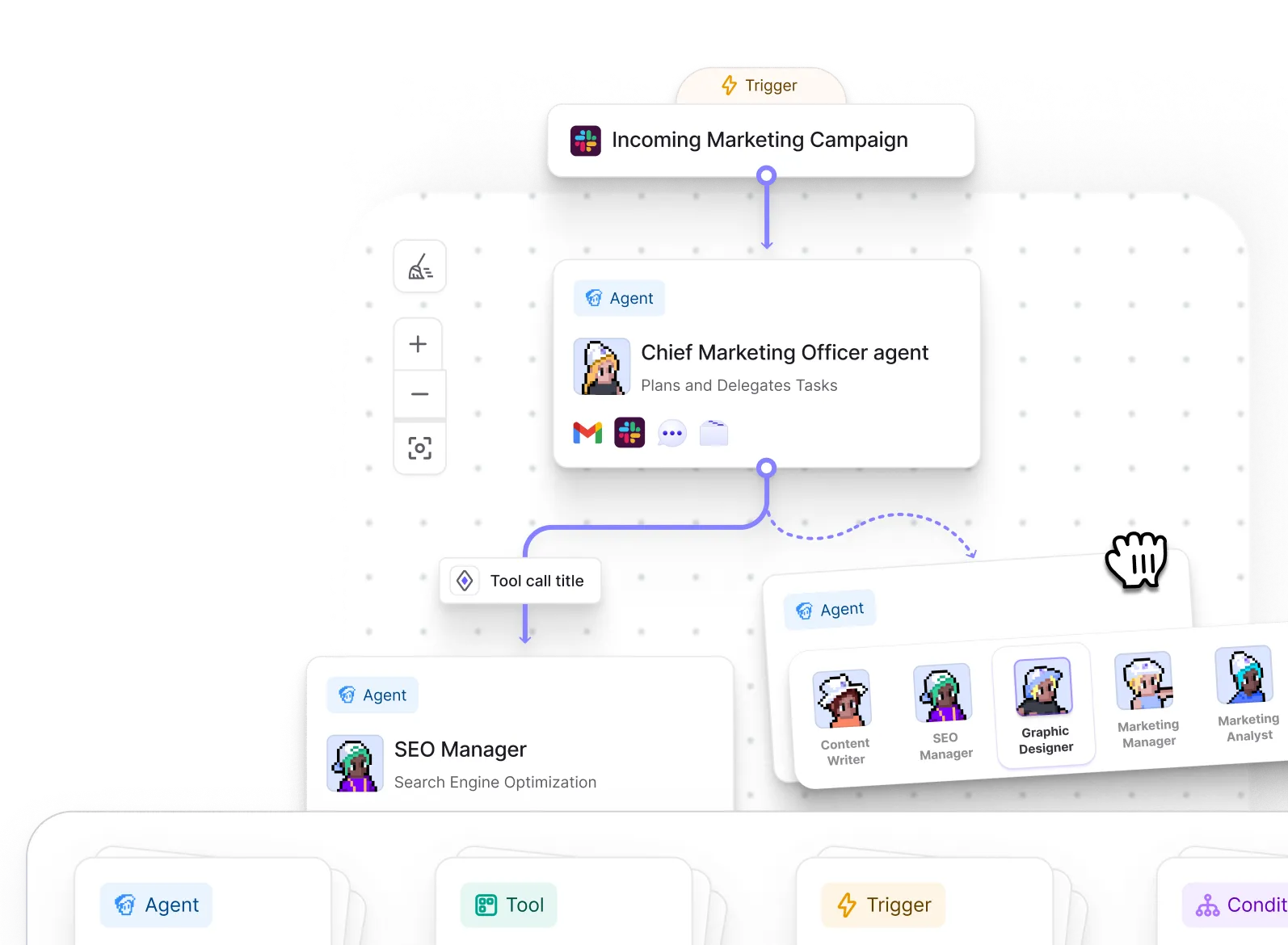
Relevance AI lets teams define agents with instructions, tools, knowledge, and triggers, then combine them into Workforces. Its marketplace includes agents for sales, marketing, support, success, research, and operations.
It is best for GTM and operations teams that want to model work as roles: a lead researcher, qualifier, CRM operator, and outreach drafter can each own one stage.
The main drawback is that flexible agents take careful testing. Usage also involves both Actions and Vendor Credits.
Read our Relevance AI review and pricing breakdown.
2. Gumloop: Best Agent and Workflow Combination
Gumloop combines visual workflows with agents that can choose tools, call workflows, use integrations, search the web, run code, and delegate to subagents.
It is a strong choice when predictable flows and open-ended agent decisions belong in the same project. Review credentials and tool permissions carefully when agents are shared across a team.
Compare Relevance AI vs Gumloop.
3. n8n: Best for Technical Control
n8n combines node-based automation with AI Agent nodes, tools, memory, webhooks, code, databases, and extensive workflow logic. It can also be self-hosted.
It is best for technical teams that need explicit routing, custom APIs, error handling, and infrastructure control. Non-technical users may find data mapping and deployment more demanding.
Compare Relevance AI vs n8n.
4. Make: Best Visual Automation Ecosystem
Make provides a mature visual Scenario Builder and a newer AI Agents experience. Agents can use modules, scenarios, knowledge, and MCP tools while operating inside Make's automation environment.
It suits teams that already rely on scenarios and want to introduce agent decisions without rebuilding the rest of their automation stack. The current new AI Agents experience is described as open beta.
Compare Relevance AI vs Make.
5. Lindy: Best for Ready-Made Business Assistants
Lindy is aimed at deploying assistants for familiar business tasks such as inbox management, meetings, sales, and support.
It is worth considering when speed matters more than designing a deep custom platform. Relevance AI and Gumloop provide more room for builders who want to construct specialized tools and multi-stage systems.
6. Stack AI: Best for Enterprise AI Applications
Stack AI focuses on building and deploying AI applications that connect to enterprise data. It is a stronger candidate when governance, internal knowledge, controlled deployment, and enterprise systems lead the buying decision.
It may be more platform than a small team needs for one operational agent.
7. CrewAI: Best Code-First Multi-Agent Framework
CrewAI is designed for developers who want to define agents, tasks, tools, and crews in code. It offers more software-development control than a no-code builder, along with the engineering responsibility that control requires.
Choose it when agents belong inside a custom application and developers will own deployment and monitoring.
How We Evaluated the Tools
We considered:
- how agents receive instructions and context
- tool and integration support
- deterministic workflow control
- multi-agent coordination
- testing, logs, and approvals
- deployment and self-hosting options
- accessibility for the intended user
- pricing clarity and production usage costs
The best tool is the one that can run one real workflow accurately, affordably, and with appropriate human oversight.
Which AI Agent Builder Should You Choose?
- Choose Relevance AI for business-owned agents and Workforces.
- Choose Gumloop for agents that orchestrate visual workflows.
- Choose n8n for self-hosting and technical workflow control.
- Choose Make for visual SaaS automation with agent steps.
- Choose Lindy for fast role-based assistants.
- Choose Stack AI for enterprise internal AI applications.
- Choose CrewAI for code-first agent systems.
Start with a reversible task such as research, classification, summarization, or drafting. Add external actions only after the agent has proven accurate on representative data.
Frequently Asked Questions About AI Agent Builders
What is an AI agent builder?
An AI agent builder is software or a development framework for creating systems that use models, instructions, knowledge, and tools to complete tasks. Some are no-code products; others are code-first frameworks.
What is the best no-code AI agent builder?
Relevance AI and Gumloop are strong options for no-code or lower-code builders. Relevance AI emphasizes agents and Workforces, while Gumloop combines agents with visual workflows.
Can AI agents update business software?
Yes, when given an authenticated integration or API tool. Permissions, approval gates, logs, and restricted test data are important before allowing write actions.
Should I use an agent or a normal automation?
Use a normal automation when the correct steps are known in advance. Use an agent when the task requires interpreting context or selecting among tools. Many reliable systems combine both.
Keep Reading