12 Best Relevance AI Templates and Agents
Contents
The fastest way to understand Relevance AI is not to build a complicated Workforce from an empty canvas. Clone one marketplace agent, connect it to sample data, and inspect how its instructions and tools produce the result.
Relevance AI's public product page currently highlights marketplace agents for sales, marketing, support, success, research, and operations. The best template is not the one with the longest feature list. It is the one closest to a repetitive job your team already understands.

Disclosure: Toolfountain may earn a commission if you buy through links in this article.
Best Relevance AI Templates at a Glance
| Agent | Department | Best use |
|---|---|---|
| Lead Research Agent | Sales | Collecting account and prospect evidence |
| Outbound BDR Agent | Sales | Coordinating research, drafting, and follow-up |
| Inbound Qualification Agent | Sales | Scoring and routing new leads |
| Deal Intelligence Agent | Sales | Preparing account and deal summaries |
| Proposal Writer Agent | Sales | Turning approved deal context into a proposal draft |
| Content Repurposing Agent | Marketing | Adapting one source into channel-specific drafts |
| SEO Optimization Agent | Marketing | Reviewing content against a defined SEO brief |
| Campaign Performance Agent | Marketing | Summarizing campaign data and changes |
| Customer Support Agent | Support | Answering from approved knowledge and escalating cases |
| Onboarding Agent | Success | Guiding customers through defined onboarding steps |
| Meeting Notes Agent | Operations | Extracting decisions, owners, and follow-ups |
| CRM Enrichment Agent | Operations | Filling and standardizing CRM records |
The marketplace changes, so confirm that an agent is still available before planning a production workflow around it.
1. Lead Research Agent
The Lead Research Agent is the most useful starting point for a sales team because its output is easy to evaluate. Give it a company and prospect, then check whether it finds accurate evidence, cites sources, and follows the research brief.
Customize the agent with your ICP, required fields, approved sources, and rules for missing data. Do not let it convert guesses into CRM facts.
Pair it with the workflow in How to use Relevance AI for lead generation.
2. Outbound BDR Agent
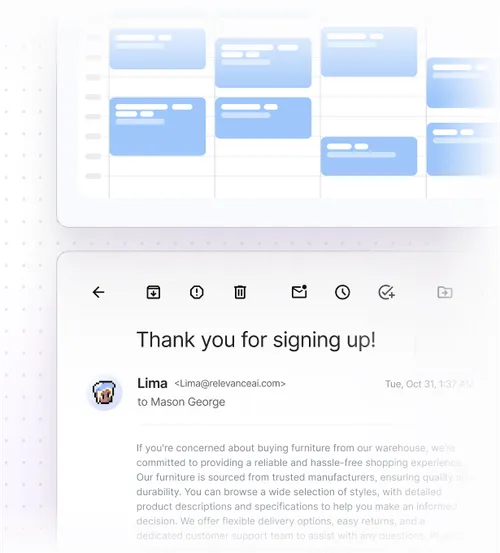
An Outbound BDR Agent is broader than a research template. It can coordinate prospect discovery, research, message drafting, follow-up, and CRM activity.
Treat this as a system to configure, not a switch to turn on. Begin with research and drafting. Add sending only after the targeting, evidence, tone, duplicate handling, and approval steps work reliably.
3. Inbound Qualification Agent
This agent evaluates new leads against written criteria and routes them to the correct owner or next step. It is useful when form fills, demo requests, or product sign-ups arrive faster than a person can research them.
Connect it to a CRM trigger, require evidence for the score, and create a human-review route for uncertain cases.
4. Deal Intelligence Agent
A Deal Intelligence Agent can gather CRM activity, account information, notes, and recent signals into a brief before a call or pipeline review.
The template becomes more useful when the output follows a fixed structure: deal stage, stakeholders, recent activity, risks, open questions, and next action.
5. Proposal Writer Agent
This agent can turn discovery notes, approved pricing, scope, customer requirements, and case-study evidence into a first proposal draft.
Keep pricing and legal language in controlled sources. Require a person to review every commitment before the proposal leaves the company.
6. Content Repurposing Agent
A Content Repurposing Agent can turn a webinar, report, interview, or long article into drafts for newsletters, LinkedIn, short posts, or sales enablement.
Useful customization includes examples of each channel, prohibited claims, tone rules, length limits, and a requirement to preserve the meaning of the source.
7. SEO Optimization Agent
An SEO Optimization Agent can compare a draft with a content brief, identify missing subtopics, inspect headings, and suggest clearer answers.
It should not stuff a keyword or rewrite every sentence. Give it the target reader, intent, primary sources, internal-link opportunities, and editorial rules.
8. Campaign Performance Agent
This agent can collect campaign results, compare periods, identify material changes, and produce a report for a marketer.
Make it distinguish measured facts from explanations. A drop in conversion is a fact; the reason for the drop is a hypothesis until supporting evidence exists.
9. Customer Support Agent
A Customer Support Agent can retrieve approved knowledge, draft answers, update tickets, and escalate cases outside its confidence or permissions.
Start with low-risk questions. Require escalation for refunds, security, legal issues, account access, and anything not covered by the knowledge base.
10. Onboarding Agent
An Onboarding Agent can answer setup questions, track completion, remind customers about the next step, and alert a customer-success manager when progress stalls.
Its instructions should define what “complete” means and when a person must intervene.
11. Meeting Notes Agent
This agent can turn transcripts into decisions, owners, deadlines, risks, and follow-up tasks. It is a practical first automation because the output is reviewable before any external action occurs.
Test name matching carefully and never assign a task that was only discussed hypothetically.
12. CRM Enrichment Agent
A CRM Enrichment Agent can retrieve missing company or contact data, standardize fields, and flag conflicts.
Use validation rules and preserve the source of each update. For high-impact fields, write suggestions to a review queue rather than overwriting existing data automatically.
How to Choose and Customize a Template
- Pick a task with a clear current process.
- Test the template with ten representative inputs.
- Inspect every tool and permission it can use.
- Replace generic instructions with your actual rules.
- Define the required output format.
- Add evidence and source requirements.
- Add approval gates before external or destructive actions.
- Measure accuracy, time saved, action usage, and exceptions.
The marketplace is a starting point. The work that makes an agent useful is adapting it to your data, process, risk, and definition of a good result.
Are Relevance AI Templates Free?
Marketplace access is included in the current Free plan, and users can clone agents to explore the platform. Running an agent consumes plan Actions and may consume Vendor Credits or credits from connected products.
Read the Relevance AI pricing guide before deploying a template at volume.
Verdict
Start with the Lead Research, Meeting Notes, or CRM Enrichment Agent. Their outputs are straightforward to verify, and none needs to send an external message during the first test.
Move to an Outbound BDR, Support, or Onboarding Agent only after your instructions, data, permissions, and escalation rules are mature.
Browse Relevance AI agents or read the Relevance AI review.
Frequently Asked Questions About Relevance AI Templates
Does Relevance AI have an agent marketplace?
Yes. Relevance AI provides a marketplace where users can browse and deploy community agents or publish their own.
Can I edit a Relevance AI marketplace agent?
Marketplace agents are intended to be cloned and adapted. Review their instructions, tools, knowledge, integrations, and permissions before using them with business data.
What is the best Relevance AI agent for beginners?
A research, meeting-notes, or enrichment agent is a good starting point because its output can be checked before the agent takes an external action.
Do Relevance AI templates use credits?
Running a cloned agent can consume Actions and Vendor Credits. Connected services such as enrichment products may also charge their own credits.
Keep Reading