Relevance AI vs StackAI: Which AI Agent Platform Is Better?
Contents
StackAI wins this comparison 5–4. It is the stronger choice for enterprise AI deployments where workflow control, governed access to company data, human oversight, security, and deployment flexibility matter from the beginning.
Relevance AI is the better fit for teams that want to build specialist Agents themselves, coordinate them visually through Workforces, connect a broad SaaS stack, and move from a permanent Free plan into transparent self-serve pricing.
- Overall winner: StackAI.
- Choose StackAI for regulated or complex enterprise AI workflows, governed RAG, private deployment, and IT-led rollouts.
- Choose Relevance AI if self-serve Agent building, visual multi-Agent Workforces, broader app coverage, and straightforward paid plans matter more.
Asana also completed its acquisition of StackAI in 2026. StackAI continues to operate through its own product, signup, pricing, documentation, and sales experience.
Relevance AI vs StackAI at a glance
- Getting started: Relevance AI wins. Its Free plan and public self-serve paid tiers make the first deployment easier.
- Workflow control: StackAI wins. It gives builders stronger visibility over AI reasoning, deterministic steps, routing, code, Knowledge, and human review.
- Multi-Agent orchestration: Relevance AI wins. Workforces give specialist Agents and their handoffs a dedicated visual layer.
- Enterprise RAG: StackAI wins. It is particularly strong when governed retrieval must sit inside a larger enterprise AI deployment.
- Integrations: Relevance AI wins. It currently documents more than 2,000 apps.
- Governance: StackAI wins. Human review, access controls, auditability, and governed production workflows are central to the platform.
- Security and deployment: StackAI wins. It supports multi-tenant, Virtual Private Cloud, and on-premise deployment options.
- End-user deployment: StackAI wins. It is strong at turning AI workflows into controlled applications for employees and customers.
- Pricing accessibility: Relevance AI wins. Public Free, Pro, and Team pricing makes it easier for smaller teams to estimate cost and upgrade.
Final score: StackAI 5, Relevance AI 4.
1. Relevance AI is easier to start with
Relevance AI gives a new Agent builder a more direct route from idea to working Agent.
A Relevance AI Agent can have its own Prompt, Tools, Knowledge, Triggers, Memory, variables, model settings, and operating instructions.
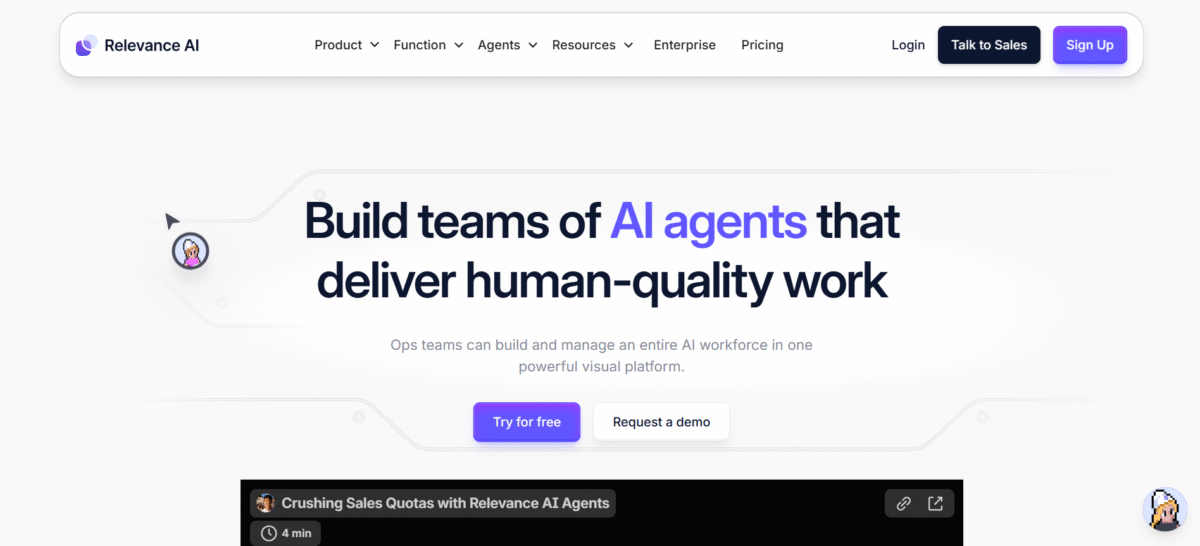
You can start with a narrow role such as a research Agent, lead qualification Agent, support Agent, or document-review Agent, then add more capabilities when the workflow proves useful.
StackAI also has a no-code visual builder and a Free plan. Its workflow model exposes more of the application architecture from the beginning, including AI components, Knowledge, integrations, inputs, outputs, code, human review, and deployment options.
That additional structure becomes valuable in complex systems. Relevance AI is easier when the immediate job is getting one useful specialist Agent running.
Winner: Relevance AI. Running score: Relevance AI 1, StackAI 0.
2. StackAI gives you more explicit workflow control
StackAI is stronger when the workflow needs to be engineered and inspected step by step.
Its visual builder can combine AI reasoning with Knowledge Bases, enterprise integrations, routing, code, data transformation, human approval, and reusable workflow components.
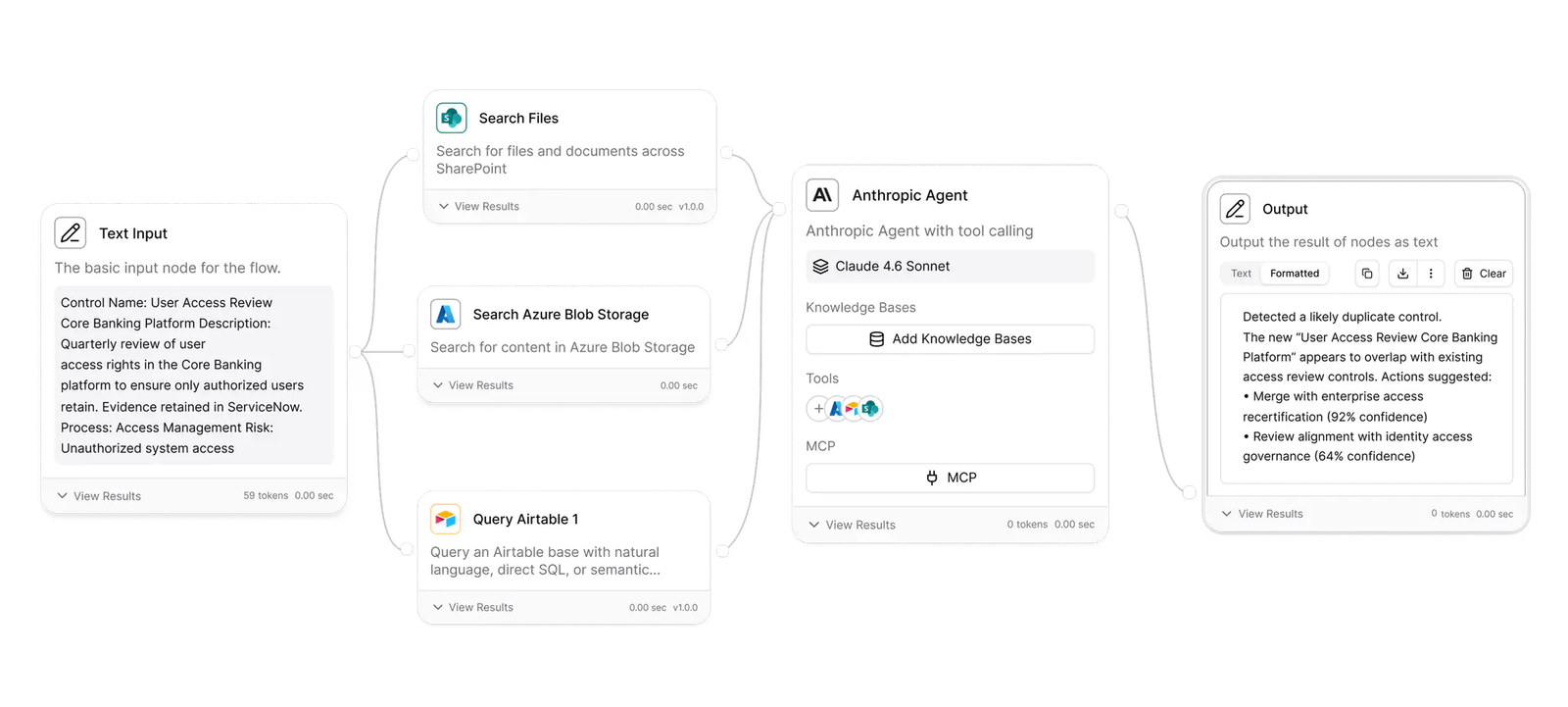
This structure works well when part of a process needs AI judgment while other steps should remain deterministic.
A compliance workflow, for example, could retrieve company policy, ask an Agent to analyze an ambiguous clause, route a high-risk finding for human approval, and then continue through a controlled business process.
Relevance AI can build sophisticated Tools and Workforces too. StackAI gives the builder more explicit control over the complete workflow architecture.
Winner: StackAI. Running score: 1–1.
3. Relevance AI has the clearer multi-Agent system
StackAI can orchestrate workflows involving several AI components. Relevance AI gives that architecture a dedicated product layer through Workforces.
The Relevance AI Workforce Builder can visually contain specialist Agents, Tools, Triggers, Conditions, AI-directed handoffs, mandatory Next Steps, and approval rules.
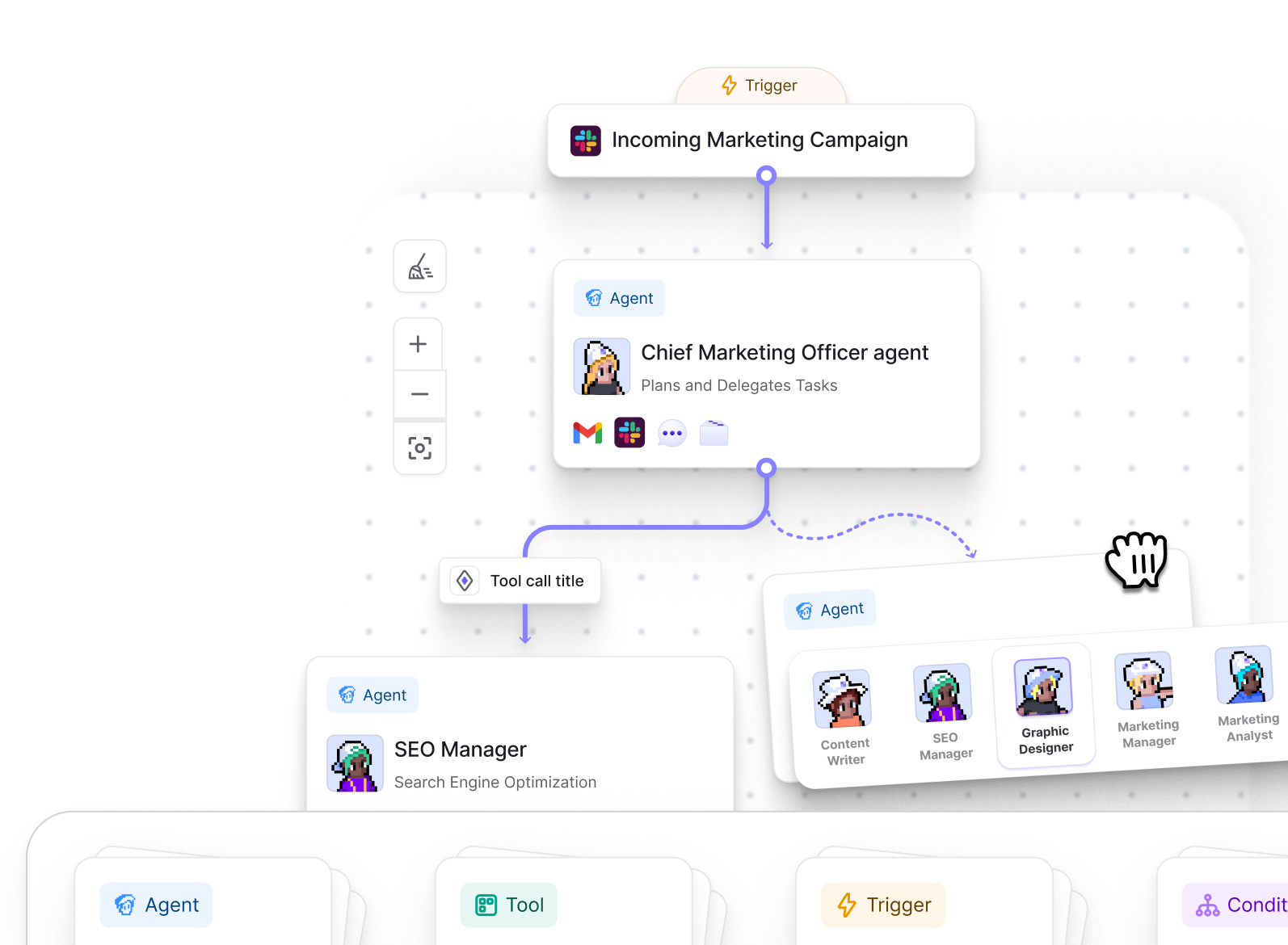
A sales Workforce might separate a Research Agent, Qualification Agent, Outreach Agent, and CRM Tool. That makes individual responsibilities and handoffs easier to inspect.
There is an important limitation. Standard Workforce connections currently support one-way Agent communication. A target Agent cannot automatically respond to the source Agent through the same connection.
StackAI can be more flexible when information needs to move through a broader workflow architecture. Relevance AI still wins this category because Workforces provide the clearer dedicated multi-Agent operating model.
Winner: Relevance AI. Running score: Relevance AI 2, StackAI 1.
4. StackAI is stronger for enterprise Knowledge and RAG
Relevance AI gives builders considerable retrieval control through Advanced Knowledge Search, including vector and keyword retrieval, hybrid search, reranking, citations, and result processing.
StackAI places heavier emphasis on enterprise Knowledge and RAG as part of production AI systems.
For a larger organization, retrieval quality is only part of the decision. Other questions matter too:
- Which repositories can the Agent access?
- Who can query the information?
- Where did an answer come from?
- How does changing source data stay synchronized?
- Where does the workload run?
Relevance AI is strong when builders want direct control over retrieval behavior. StackAI wins when RAG needs to sit inside a broader governed enterprise deployment.
Winner: StackAI. Running score: 2–2.
5. Relevance AI has the larger integration catalog
Relevance AI currently documents 2,000+ app integrations.
StackAI advertises 100+ enterprise integrations that can read, write, and execute tasks across connected systems.
StackAI focuses heavily on enterprise systems and company data sources. Relevance AI gives you better odds of finding a ready-made connection when your workflow spans a longer tail of SaaS products.
The headline number should not decide the purchase on its own. Check whether the exact trigger, read operation, write operation, and authentication method your workflow requires are actually supported.
Our Relevance AI integrations guide covers several useful CRM, email, support, productivity, and sales connections.
Winner: Relevance AI. Running score: Relevance AI 3, StackAI 2.
6. StackAI is stronger for enterprise governance and human oversight
Relevance AI supports human approval inside Workforces, while its Enterprise offering adds SSO, role-based access control, audit logs, Work Hour Controls, multi-organization management, dedicated account support, and custom implementation.
StackAI makes governance a particularly visible part of the enterprise workflow lifecycle.
Its current platform emphasizes feature controls, audit logs, human-in-the-loop approval, workflow oversight, and dedicated support from AI experts.
That becomes important when IT, security, compliance, or legal teams need to approve an Agent before it reaches production.
Winner: StackAI. Running score: StackAI 3, Relevance AI 3.
7. StackAI has stronger deployment options
Deployment flexibility is one of StackAI’s clearest advantages.
StackAI currently advertises multi-tenant, Virtual Private Cloud, and on-premise deployment, with security material aimed at organizations that need tighter infrastructure and data controls than a standard shared SaaS setup provides.
Relevance AI also provides enterprise security and governance capabilities through its Enterprise offering.
StackAI wins because private infrastructure and deployment flexibility are much more explicit parts of its current product proposition.
Winner: StackAI. Running score: StackAI 4, Relevance AI 3.
8. StackAI gives you more ways to deploy the finished Agent
Building an Agent is only part of the project. Employees or customers eventually need a usable way to interact with it.
StackAI emphasizes turning workflows into enterprise applications that can sit on top of company systems and data rather than forcing end users to work inside the builder itself.
Relevance AI can also expose Agents through conversational experiences, integrations, APIs, SDKs, and other deployment routes.
StackAI gets the edge because the end-user application layer is especially prominent in how it packages enterprise AI projects.
Winner: StackAI. Running score: StackAI 5, Relevance AI 3.
9. Relevance AI is easier to buy without an enterprise sales process
The pricing structures target different buyers.
Relevance AI pricing
Relevance AI’s current documentation lists:
- Free: $0/month with 200 Actions per month.
- Pro: $29/month or $19/month with annual billing.
- Team: $349/month or $234/month with annual billing.
- Enterprise: custom.
The Free plan also includes $2 in one-time bonus Vendor Credits, unlimited Agents and Tools, one Workforce, one user, and one project.
Pro includes 2,500 Actions per month and $20 in monthly Vendor Credits. Team includes 7,000 Actions per month and $70 in monthly Vendor Credits, alongside higher collaboration and management limits.
Our Relevance AI pricing guide covers the plans and usage model in more detail. You can also check the current Relevance AI pricing directly.
StackAI pricing
StackAI’s current public pricing starts with:
- Free: $0/month with 500 runs per month, two projects, one seat, and community support.
- Enterprise: custom pricing.
The Enterprise route is aimed at organizations that need broader deployment, higher usage, governance, implementation help, and infrastructure controls.
You can review StackAI’s current pricing before deciding whether the Free or Enterprise route fits.
Relevance AI wins this category because a smaller team can see what a paid upgrade costs without immediately entering an enterprise sales process.
Winner: Relevance AI. Final score: StackAI 5, Relevance AI 4.
What does Asana’s StackAI acquisition mean?
Asana has completed its acquisition of StackAI.
Asana describes StackAI as a no-code AI workflow platform for designing, testing, deploying, and governing custom AI Agents and intelligent automation across business-critical workflows.
The acquisition makes Asana relevant to StackAI’s future direction. Buyers should still evaluate the StackAI product available today rather than assuming a future bundle, price, or integration that has not been announced.
Relevance AI vs StackAI: which should you choose?
Frequently Asked Questions About Relevance AI vs StackAI
Is StackAI better than Relevance AI?
StackAI is our overall winner for enterprise AI deployments that prioritize governed workflows, enterprise RAG, human oversight, security, and deployment flexibility. Relevance AI is the better fit for many smaller teams that prioritize self-serve Agent building, visual Workforces, broad integrations, and public paid pricing.
Does StackAI have a free plan?
Yes. StackAI currently offers a Free plan with 500 runs per month, two projects, one seat, and community support.
Which has more integrations, Relevance AI or StackAI?
Relevance AI currently documents more than 2,000 apps, while StackAI advertises more than 100 enterprise integrations. Check the actual triggers and actions you need rather than choosing based on integration count alone.
Can StackAI be deployed on-premise?
Yes. StackAI publicly advertises on-premise deployment as part of its enterprise offering, alongside Virtual Private Cloud and multi-tenant options.
Did Asana buy StackAI?
Yes. Asana announced that it completed its acquisition of StackAI in 2026.
Which is cheaper for a small team?
Relevance AI has the clearer paid route for a small team because it publicly lists Pro and Team prices in addition to its Free plan. StackAI currently lists a Free plan followed by custom Enterprise pricing.