Relevance AI vs CrewAI: Which AI Agent Platform Is Better?
Contents
Relevance AI wins this comparison 5–4. It is the better choice for most business teams that want to build and operate AI Agents without turning the project into an engineering platform.
Relevance AI gives you the easier self-serve buying path, a clearer visual Workforce model, managed Knowledge, and a larger ready-made integration catalog.
CrewAI is the stronger choice for engineering-led teams. Its open-source Python framework, deterministic Flows, code export, observability, and infrastructure control give developers much more ownership of the underlying system.
- Overall winner: Relevance AI.
- Choose Relevance AI for business-owned Agents, visual multi-Agent Workforces, managed Knowledge, broad integrations, and self-serve pricing.
- Choose CrewAI if source-code ownership, Python-level control, deterministic orchestration, observability, and deployment flexibility are more important.
Relevance AI vs CrewAI at a glance
- Getting started: Relevance AI wins. It gives business users a more direct path from an Agent idea to a working Agent.
- Developer control: CrewAI wins. The open-source framework gives developers deeper code and infrastructure ownership.
- Deterministic workflows: CrewAI wins. Flows provide explicit state, events, routing, branching, and sequencing.
- Visual multi-Agent orchestration: Relevance AI wins. Workforces make specialist Agents and their handoffs easier to inspect.
- Integrations: Relevance AI wins. It currently documents more than 2,000 apps.
- Knowledge and RAG: Relevance AI wins. Managed Knowledge is easier for a business team to configure without engineering its own retrieval layer.
- Testing and observability: CrewAI wins. Its current hosted platform includes tracing, OpenTelemetry, LLM testing, metrics, guardrails, and other production controls.
- Deployment flexibility: CrewAI wins. You can use the open-source runtime or deploy through CrewAI’s managed and enterprise infrastructure options.
- Self-serve pricing: Relevance AI wins. Public Free, Pro, and Team tiers give smaller teams a clearer upgrade route.
Final score: Relevance AI 5, CrewAI 4.
1. Relevance AI is easier to start with
CrewAI is considerably easier to approach than its developer-framework reputation suggests.
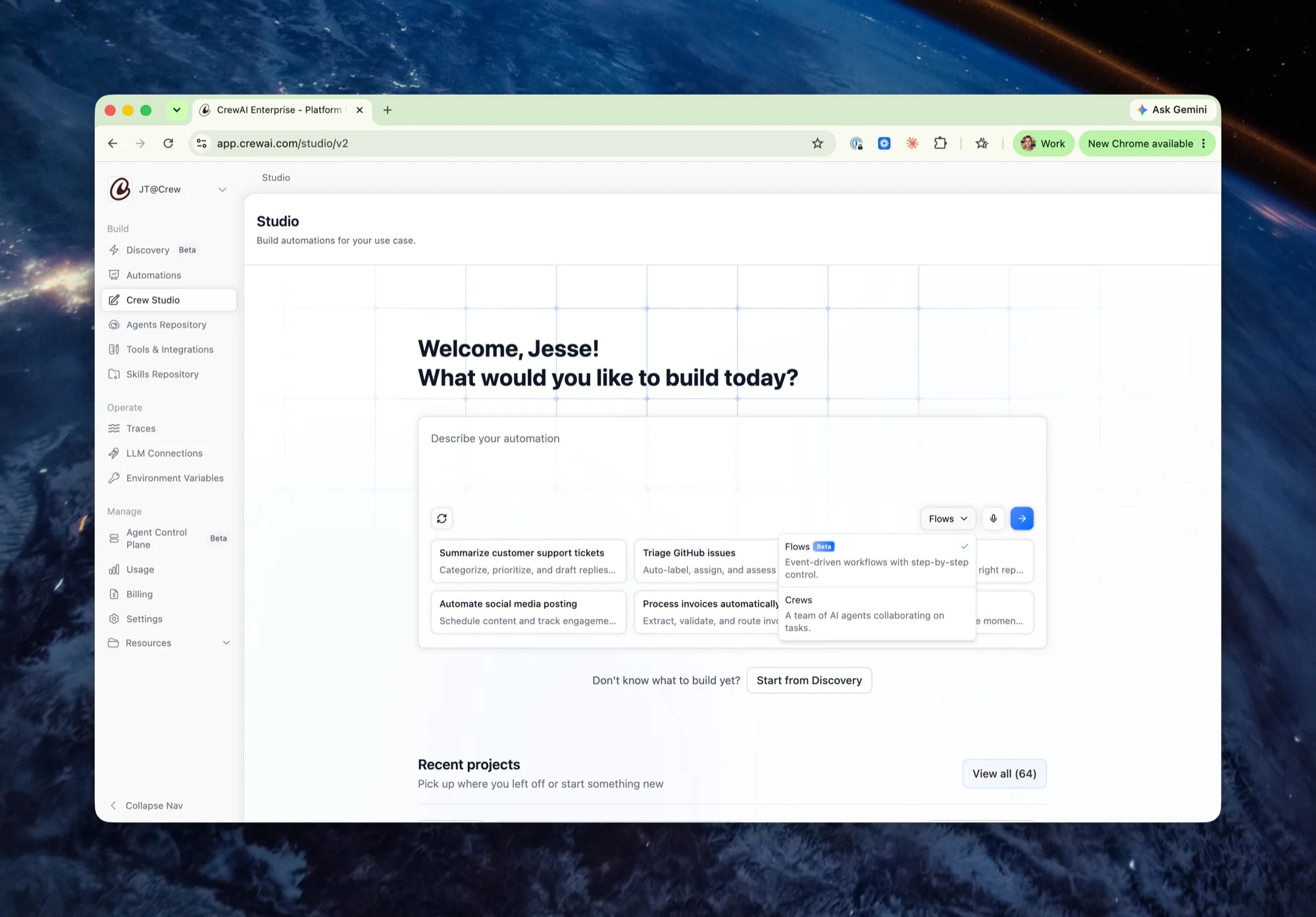
Crew Studio now provides a visual editor and AI-assisted building experience. Teams can configure Agents, tasks, Tools, and workflow relationships on a canvas without beginning in Python.
Relevance AI still has the simpler starting model for a business user.
A Relevance AI Agent is organized around familiar components such as instructions, Tools, Knowledge, Triggers, Memory, variables, and model settings.
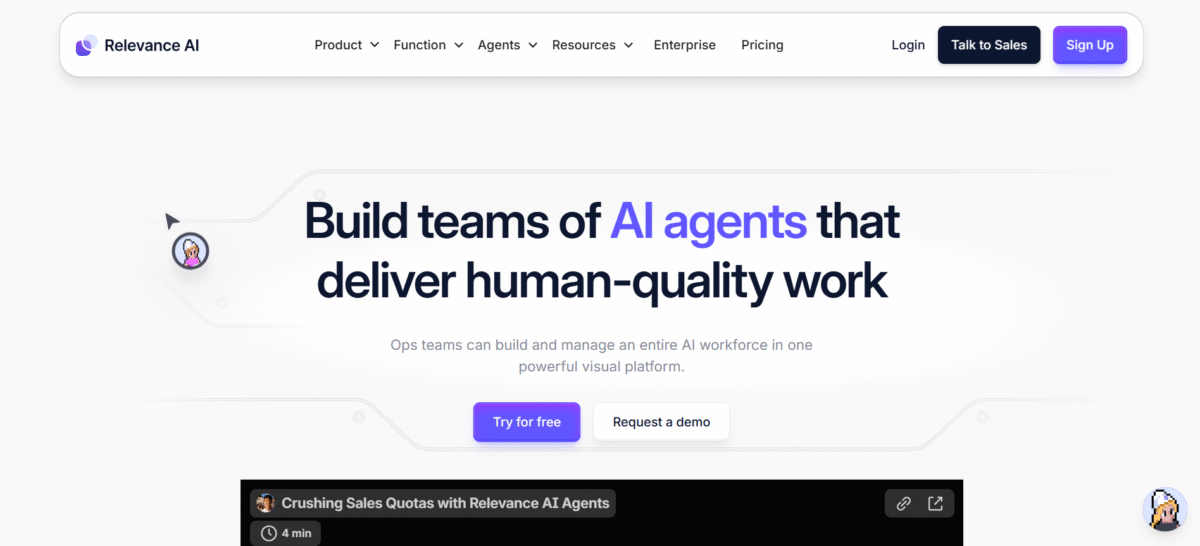
The Free plan also gives you 200 Actions per month, unlimited Agents and Tools, and one Workforce. That is enough to learn how the platform works before paying.
CrewAI Basic is free too. Its current hosted plan includes two automations and 50 workflow executions per month, alongside Studio, standard Tools and triggers, GitHub integration, tracing, and other production features.
Relevance AI wins because its product model asks less of the buyer before the first Agent becomes useful.
Winner: Relevance AI. Running score: Relevance AI 1, CrewAI 0.
2. CrewAI gives developers much more ownership
This is CrewAI’s clearest advantage.
The CrewAI open-source framework is a Python framework released under the MIT License. Developers can inspect and modify the implementation, build custom Tools, connect different models, and run the framework on infrastructure they control.
Crew Studio also reduces the usual divide between a visual prototype and an engineering-owned system.
A workflow built visually can be downloaded as source for local development and customization. CrewAI’s current homepage describes the visual editor as exportable to Python.
That means a business or operations team can help shape the first workflow without forcing engineering to rebuild the whole system if it becomes important later.
Relevance AI gives technical teams APIs, SDKs, custom Tools, code steps, MCP, and custom integrations. You are still operating inside Relevance AI’s platform architecture.
If owning the implementation itself is a requirement, CrewAI wins.
Winner: CrewAI. Running score: 1–1.
3. CrewAI has the stronger deterministic workflow model
CrewAI separates autonomous collaboration from controlled workflow execution particularly well.
Crews coordinate role-based Agents that can collaborate on work.
Flows provide the structure around that work. CrewAI’s current documentation recommends Flows for production applications because they own state and execution order while Agents do the judgment-heavy work inside the process.
Flows support capabilities including:
- state management;
- event-driven execution;
- conditional routing;
- branching;
- persistence;
- and combining ordinary code with Agents or full Crews.
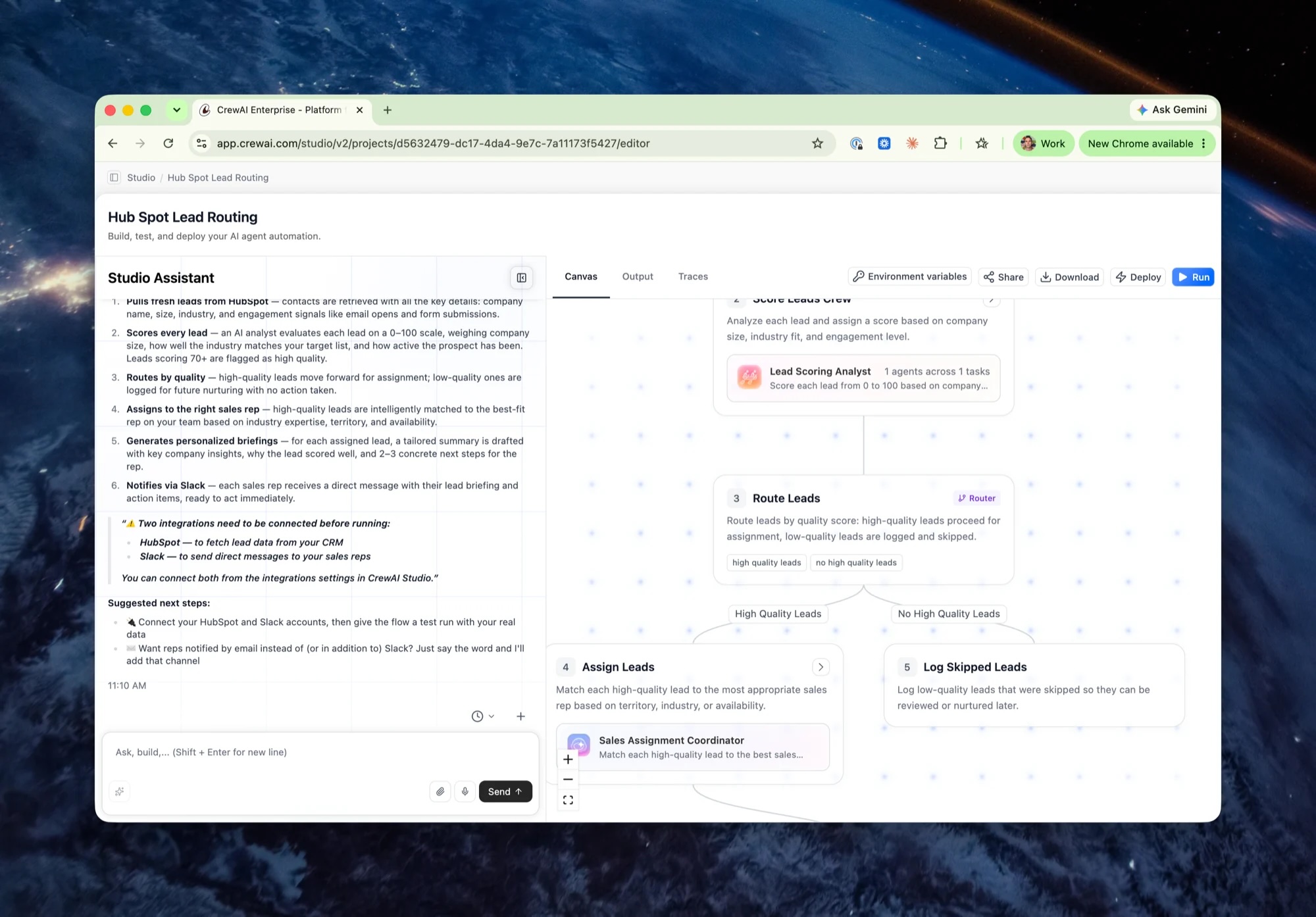
This lets an engineering team keep predictable business logic deterministic and use Agents only where judgment is actually useful.
Relevance AI supports Tools, Triggers, Conditions, mandatory Next Steps, and other controls inside its Agent and Workforce system.
CrewAI wins because Flows are a deeper dedicated orchestration layer rather than controls built around an Agent-first architecture.
Winner: CrewAI. Running score: CrewAI 2, Relevance AI 1.
4. Relevance AI has the clearer visual multi-Agent system
Both products support genuine multi-Agent work.
CrewAI Crews coordinate role-based Agents and can sit inside larger Flows. The underlying framework gives developers significant control over how those Agents collaborate.
Relevance AI makes the Agent team easier for a business user to see.
Relevance AI Workforces place separate specialist Agents on a shared canvas alongside Tools, Conditions, Triggers, and connections.
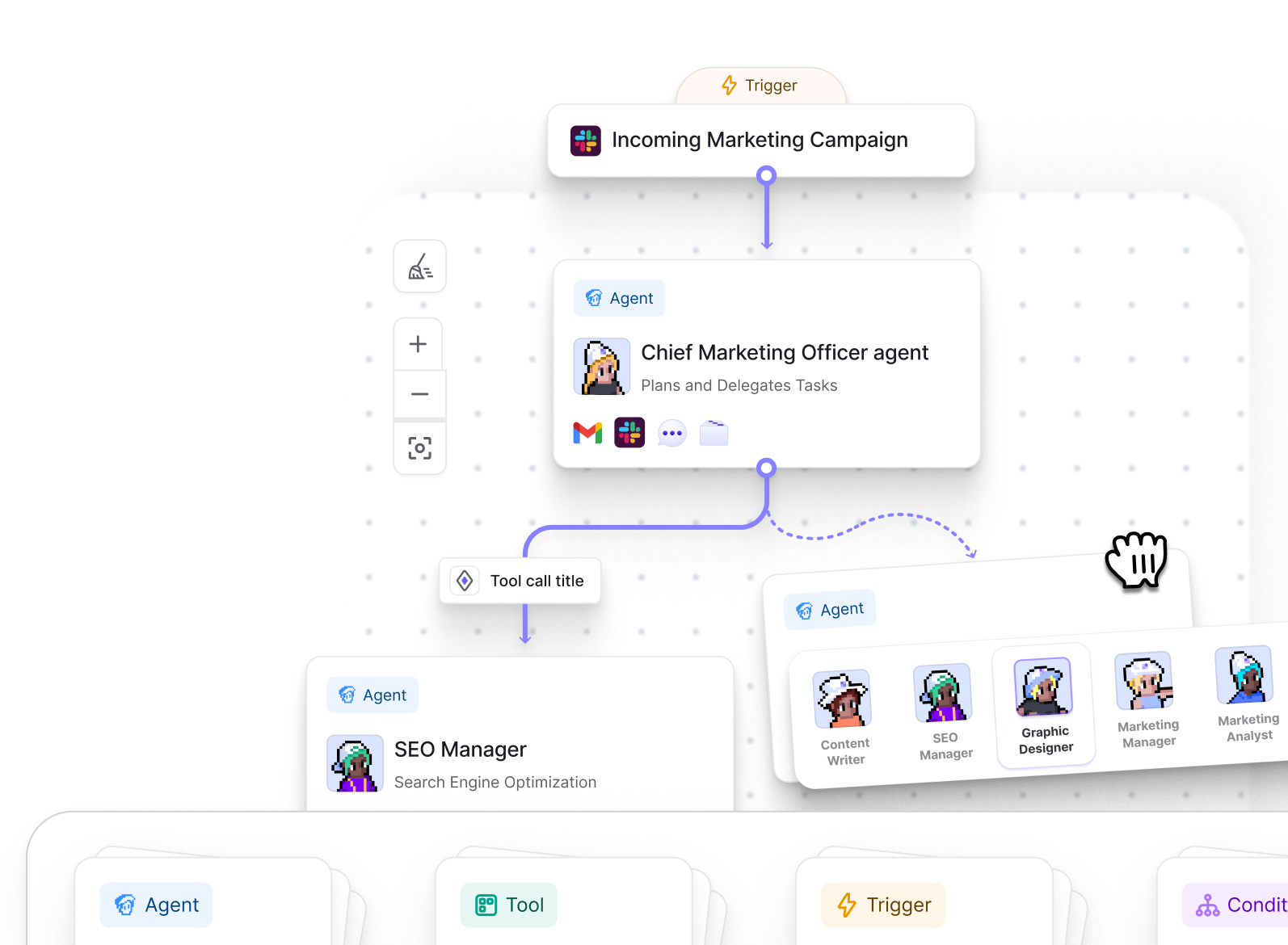
A sales Workforce might visibly contain a Research Agent, Qualification Agent, Outreach Agent, and CRM Tool. An operations team can understand who is responsible for each part of the process without thinking in Python classes or Flow events.
There is a tradeoff. Current Workforce connections still use one-way Agent-to-Agent communication. CrewAI now has much deeper Agent-to-Agent capabilities through its framework and A2A support.
Relevance AI still wins this category because the visual Workforce itself is easier to operate as a recognizable team of specialist AI workers.
Winner: Relevance AI. Running score: 2–2.
5. Relevance AI has the broader ready-made integration catalog
Relevance AI currently documents 2,000+ integrations.
That catalog spans CRM, email, productivity, support, marketing, data, project-management, communication, and other business systems.
CrewAI’s hosted Basic plan includes standard Tools and triggers, while Enterprise adds enterprise connectors. The open-source framework also gives developers routes through custom Tools, APIs, MCP, and Python integrations.
So the decision is less about whether CrewAI can connect to something and more about how much integration work your team wants to own.
If you want a ready-made business-app catalog, Relevance AI wins. If your engineering team is comfortable building the integration layer itself, CrewAI’s ceiling is much higher than a connector count suggests.
See our Relevance AI integrations guide for several useful CRM, email, sales, support, and productivity connections.
Winner: Relevance AI. Running score: Relevance AI 3, CrewAI 2.
6. Relevance AI makes Knowledge and RAG easier for business teams
CrewAI has substantial Knowledge and Memory capabilities. Developers can connect sources, configure retrieval behavior, attach Knowledge to Agents, and build more customized retrieval architectures.
Its current open-source product goes beyond simple retrieval as well, with Memory, Knowledge, checkpointing, Tools, and other Agent primitives available inside the framework.
Relevance AI makes the Knowledge layer easier to operate without owning the implementation underneath it.
Its Agents can use connected and uploaded Knowledge, while Advanced Knowledge Search provides controls for vector and keyword retrieval, hybrid search, reranking, citations, and result processing.
That is a strong fit when an operations, sales, or support team wants to ground an Agent in internal information without becoming responsible for a custom RAG stack.
Winner: Relevance AI. Running score: Relevance AI 4, CrewAI 2.
7. CrewAI is stronger for observability and production debugging
CrewAI becomes particularly compelling after an Agent workflow matters enough to require serious debugging.
The current CrewAI Basic plan already includes capabilities such as:
- tracing;
- OpenTelemetry;
- AI Agent training;
- LLM testing;
- guardrails;
- human-in-the-loop input;
- token counts;
- performance metrics;
- hallucination scores;
- and deployment history.
CrewAI’s built-in tracing can expose Agent decisions, task execution, Tool usage, and LLM calls across Crews and Flows.
Relevance AI has task histories, Activity Center, cost information, analytics on Team, A/B testing, and a sophisticated Eval system with scenarios and reusable Checks.
The limitation is access. Relevance AI Evals currently roll out from Enterprise, and the pricing documentation lists Agent Evaluations on Enterprise.
CrewAI therefore gives more of its observability and testing stack to builders earlier.
Winner: CrewAI. Running score: Relevance AI 4, CrewAI 3.
8. CrewAI gives you more deployment control
The CrewAI open-source runtime can run independently of the hosted product, which changes the deployment comparison immediately.
CrewAI Enterprise can also run on CrewAI infrastructure, a dedicated VPC, or customer infrastructure. Its current pricing page places those infrastructure controls alongside governance features such as SSO, RBAC, workload identity, PII redaction, and policies.
Relevance AI provides Enterprise security controls including SSO, RBAC, audit logs, multi-organization management, and custom implementation.
CrewAI wins because the combination of an independently runnable open-source framework, code export, and enterprise deployment options gives technical teams more control over where the final system lives.
Winner: CrewAI. Running score: 4–4.
9. Relevance AI has the clearer self-serve pricing path
The hosted pricing tells you a lot about the audiences each company is currently prioritizing.
Relevance AI pricing
Relevance AI’s documentation currently lists:
- Free: $0/month with 200 Actions per month.
- Pro: $29/month or $19/month with annual billing.
- Team: $349/month or $234/month with annual billing.
- Enterprise: custom.
Pro includes 2,500 Actions per month and $20 in monthly Vendor Credits. Team increases that to 7,000 Actions and $70 in monthly Vendor Credits.
There is currently a presentation difference between Relevance AI’s pages. The main marketing pricing page foregrounds Enterprise, while the official pricing documentation still lists the Free, Pro, Team, and Enterprise structure above.
Our Relevance AI pricing guide tracks the current plans and usage model in more detail. You can also check Relevance AI’s current pricing.
CrewAI pricing
CrewAI’s current hosted pricing is:
- Basic: Free.
- Enterprise: custom.
Basic currently includes two automations and 50 workflow executions per month, along with the visual editor, AI copilot, GitHub integration, standard Tools and triggers, tracing, LLM testing, guardrails, and other build and observability features.
Enterprise adds custom execution capacity, enterprise connectors, governance, dedicated infrastructure options, SSO, RBAC, support, and onboarding.
You can review CrewAI’s current hosted plans directly.
The open-source framework is a separate route. You can run it yourself rather than buying CrewAI’s hosted Enterprise product, but then infrastructure, model usage, maintenance, and engineering become part of your real cost.
Relevance AI wins because the buyer who wants a hosted platform can move from Free to a relatively inexpensive paid tier without jumping directly into enterprise procurement.
Winner: Relevance AI. Final score: Relevance AI 5, CrewAI 4.
Relevance AI vs CrewAI: which should you choose?
Frequently Asked Questions About Relevance AI vs CrewAI
Is CrewAI better than Relevance AI?
CrewAI is better for engineering teams that want open-source code, deterministic Flows, deep observability, and infrastructure control. Relevance AI is our overall winner for business teams that want a managed Agent platform, visual Workforces, broad integrations, managed Knowledge, and self-serve pricing.
Does CrewAI require coding?
No. Crew Studio provides a visual editor and AI-assisted building experience. CrewAI still has a much higher technical ceiling because the underlying framework is Python-based and Studio projects can be exported for code-level customization.
Is CrewAI open source?
Yes. CrewAI’s core framework is open source under the MIT License. CrewAI also sells a commercial hosted and enterprise platform for building, deploying, observing, governing, and scaling Agent workflows.
Which is better for developers?
CrewAI. Developers get an open-source Python framework, Crews, event-driven Flows, custom Tools, code ownership, tracing, and more control over deployment and infrastructure.
Which is cheaper for a small team?
Both have free hosted entry points, but Relevance AI has the clearer paid path for a small team because Pro is publicly priced at $29 per month or $19 per month with annual billing. CrewAI’s hosted pricing currently moves from Basic Free to custom Enterprise, although developers can also self-host the open-source framework.