Relevance AI vs AirOps: Which Is Better for AI Agents and Content Automation?
Contents
AirOps wins this comparison 5–4. For content, SEO, AEO, and AI-search teams, it gives you a more complete system for finding opportunities, turning them into content work, maintaining brand context, getting human approval, publishing to your CMS, and measuring what happens next.
Relevance AI is the better platform if content is only one of several jobs you want AI Agents to handle. Its specialist Agents and Workforces can operate across sales, support, operations, research, HR, marketing, and other business processes.
- Overall winner: AirOps.
- Choose AirOps if your main problem is content production, SEO, AEO, content refreshes, AI-search visibility, brand governance, or CMS execution.
- Choose Relevance AI if you want one general-purpose Agent platform across several departments.
Relevance AI vs AirOps at a glance
- General-purpose AI Agents: Relevance AI wins. It is designed for specialist Agents across multiple departments and jobs.
- Content, SEO, and AEO automation: AirOps wins. Its platform is purpose-built around content operations and AI-search growth.
- AI-search visibility: AirOps wins. Insights feeds visibility signals into the same system used to plan and execute content work.
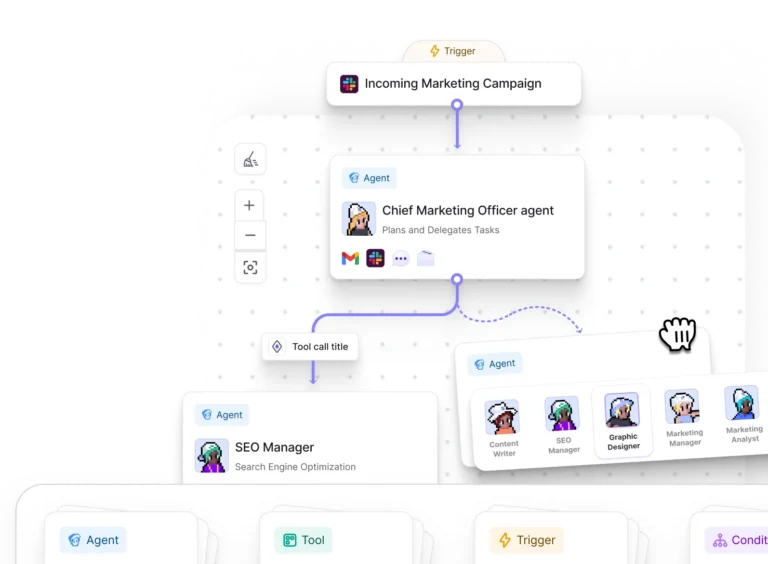
- Multi-Agent orchestration: Relevance AI wins. Workforces provide a dedicated visual environment for coordinating multiple specialist Agents.
- Content workflows and human review: AirOps wins. Playbooks, Workflows, approval gates, and editorial review are designed around content production.
- Brand governance: AirOps wins. Brand Kit provides structured, reusable brand context with version history and approval controls.
- Integration breadth: Relevance AI wins. It currently documents more than 2,000 apps.
- Bulk content and CMS publishing: AirOps wins. It can import CMS collections, process content in bulk, and send approved work back to the CMS.
- Pricing accessibility: Relevance AI wins. Its Free, Pro, and Team pricing is easier to understand before creating an account or contacting sales.
Final score: AirOps 5, Relevance AI 4.
1. Relevance AI is better for general-purpose AI Agents
Relevance AI wins when content is only one job in a much larger Agent strategy.
A Relevance AI Agent can have its own instructions, Tools, Knowledge, Triggers, Memory, variables, and model configuration.
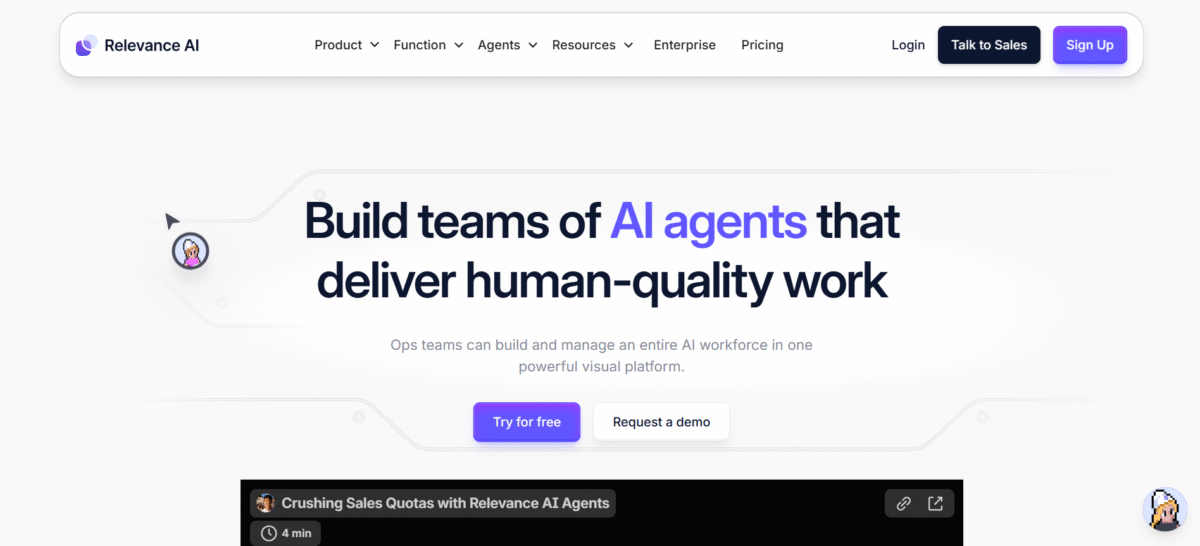
The same platform can be used to build Agents for jobs such as:
- lead research and qualification;
- sales operations;
- customer support;
- research;
- CRM work;
- HR workflows;
- operations;
- marketing;
- and content.
AirOps has moved further toward Agent-driven execution with Quill, but its product remains much more specialized around marketing content and AI search.
If you need one Agent platform across several departments, that specialization becomes a limitation rather than an advantage.
Winner: Relevance AI. Running score: Relevance AI 1, AirOps 0.
2. AirOps is better for content, SEO, and AEO automation
AirOps has already assembled much of the infrastructure a serious content team would otherwise need to build around a general-purpose Agent platform.
The current AirOps platform combines capabilities including:
- Quill;
- AI-search Insights;
- Playbooks;
- Workflows;
- Grids;
- Brand Kit;
- Knowledge Bases;
- human review;
- SEO and research integrations;
- and CMS publishing.
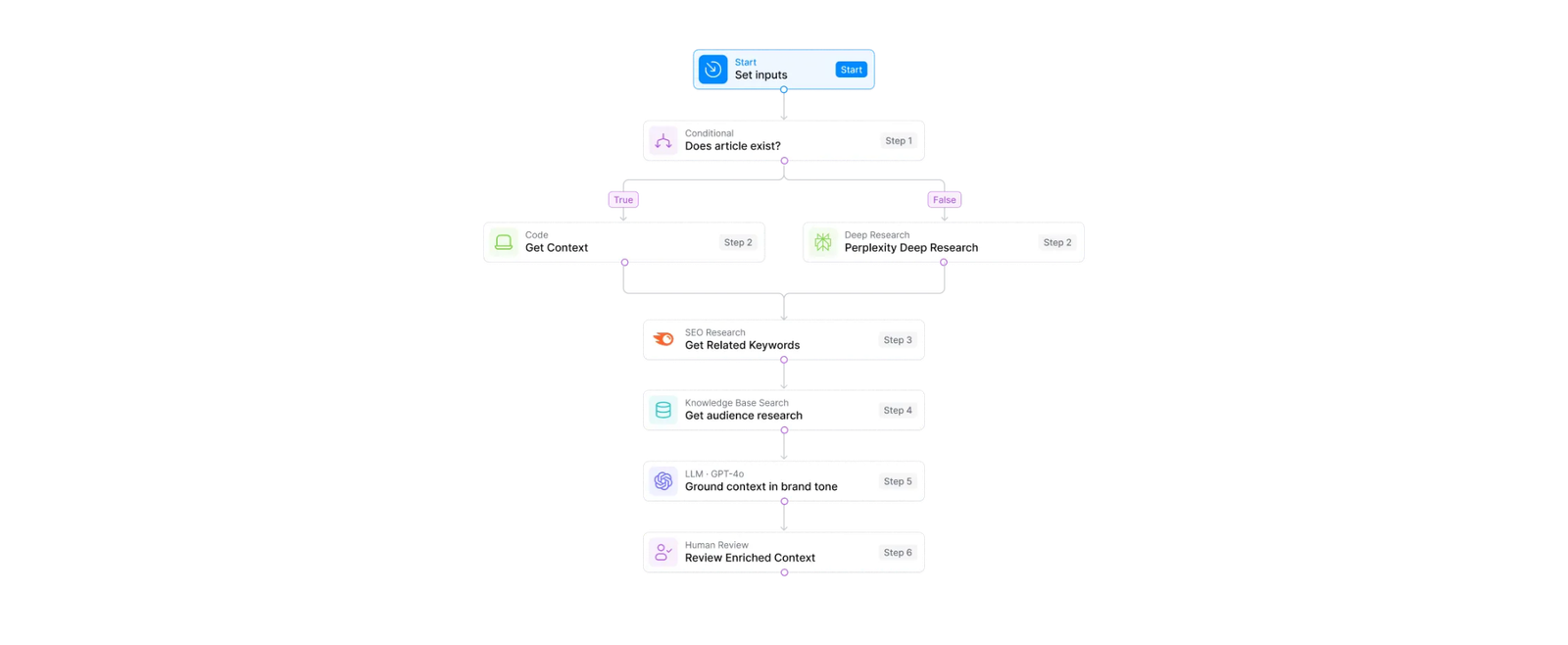
That gives AirOps a more natural starting point for jobs such as:
- content refreshes;
- new article creation;
- SEO optimization;
- AEO optimization;
- programmatic content;
- internal-link updates;
- content enrichment;
- brand-wide positioning updates;
- and publishing.
Relevance AI can build Agents and Tools for many of these jobs. AirOps gives the content team more of the surrounding operating system from the start.
Winner: AirOps. Running score: 1–1.
3. AirOps connects AI-search visibility to the work that follows
AirOps’ biggest advantage is that measurement and execution live unusually close together.
AirOps Insights is built around understanding how a brand and its content perform across AI search and traditional search signals.
Quill can then use that context to surface and execute work.
For example, the system can help a content team identify:
- important prompts where the brand is missing;
- pages losing visibility or citations;
- content gaps worth addressing;
- offsite sources influencing AI answers;
- or existing pages that should be refreshed.
Quill sits on top of this system as AirOps’ AI Agent captain. AirOps says Quill can monitor signals, recommend Campaigns, execute accepted work, route output for review, and feed results back into later decisions.
Relevance AI can connect Agents to analytics, SEO, research, and publishing systems, then use those Tools to make decisions. AirOps has already made the signal-to-content loop a core product workflow.
Winner: AirOps. Running score: AirOps 2, Relevance AI 1.
4. Relevance AI has the clearer multi-Agent architecture
AirOps now has a much stronger Agent layer than it did before Quill.
Teams can define strategy in Playbooks, and Quill can execute against that strategy using the content systems and context available inside AirOps.
Relevance AI goes further when the requirement is a visible team of separate specialist Agents.
Its Workforce Builder lets you connect Agents, Tools, Triggers, Conditions, and handoffs on one canvas.
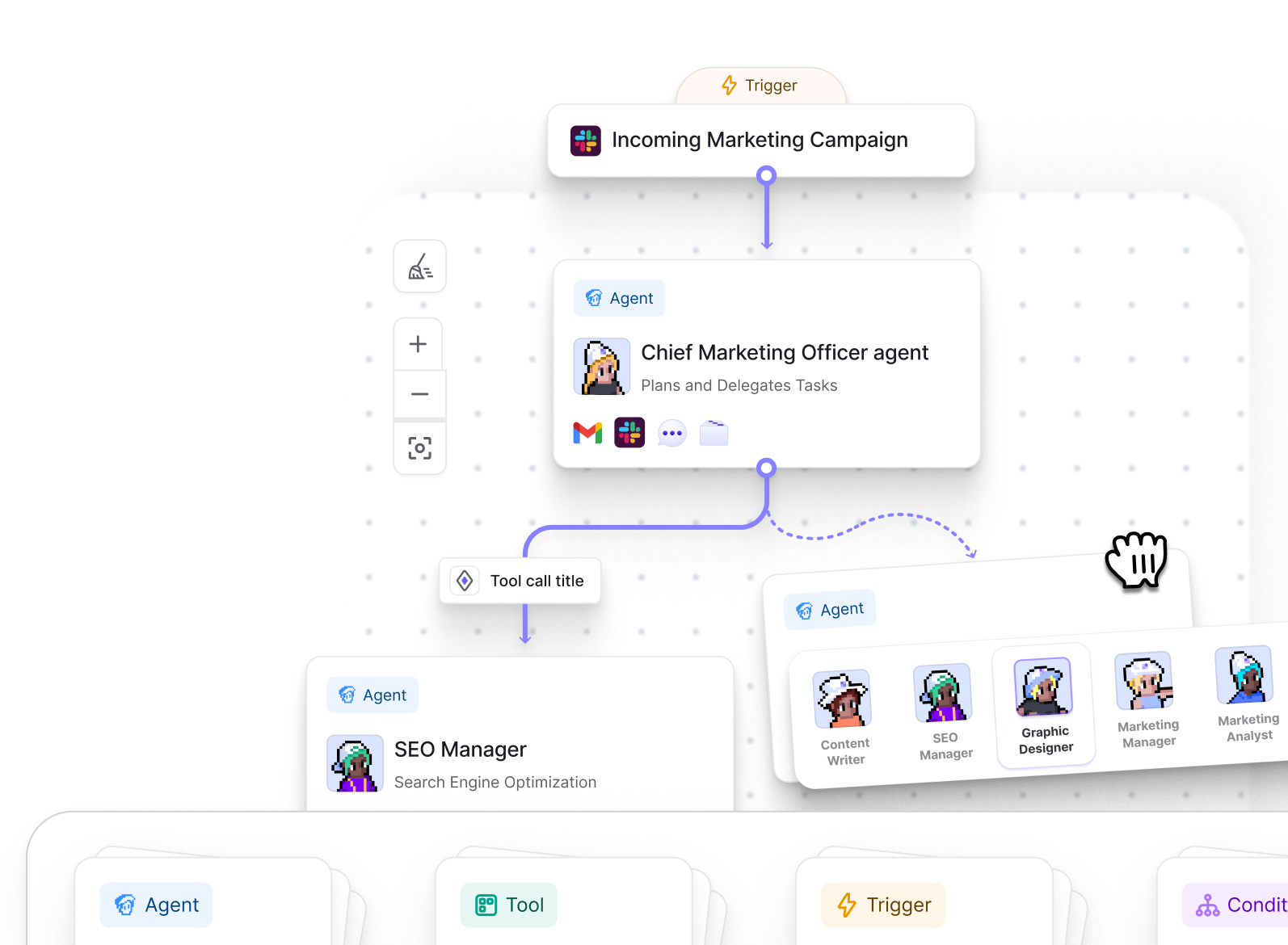
A content Workforce could separate:
- Research Agent;
- SERP Analysis Agent;
- Content Agent;
- Review Agent;
- and publishing Tools.
Each role is visible as a distinct component of the process.
That architecture is useful well beyond content too. A Workforce could coordinate sales, support, operations, finance, or research Agents in the same way.
Our Relevance AI Workforces guide goes deeper into how the multi-Agent system works and where its current limitations sit.
Winner: Relevance AI. Running score: 2–2.
5. AirOps is better for repeatable content workflows and human review
AirOps gives content teams different execution layers depending on how predictable the job is.
Playbooks for work that needs judgment
AirOps currently recommends Playbooks for jobs where the exact path can change depending on the content and context.
That includes work such as:
- briefs;
- content refreshes;
- rewrites;
- and other editorial jobs where one rigid sequence will not fit every page.
Teams define goals, channels, voice, and success criteria, while Quill interprets those instructions during execution.
Workflows for predictable operations
AirOps Workflows remain useful when the steps should stay consistent, such as extraction, transformation, enrichment, or other repeatable processes.
AirOps also supports human approval points so people can review important outputs before the process continues.
That split between Agent judgment and deterministic content operations is particularly well suited to editorial workflows.
Winner: AirOps. Running score: AirOps 3, Relevance AI 2.
6. AirOps has stronger dedicated brand governance
Both products can ground AI output in company information. AirOps has gone much further in packaging brand context specifically for marketing and content teams.
AirOps Brand Kit can structure information around areas such as:
- brand foundations;
- product lines and positioning;
- audiences;
- tone of voice;
- content types;
- regions;
- writing rules;
- and visual guidelines.
AirOps separates this from Knowledge Bases, which are better suited to larger sources and datasets such as case studies, research, support material, and internal-link information.
Brand Kit also includes version history. Changes are reviewable and reversible, with a diff view for inspecting what changed.
AirOps can expose the same brand context to compatible external AI tools through MCP, which helps teams maintain one shared source of brand instructions.
Relevance AI can build on-brand Agents with instructions, Knowledge, variables, Tools, approvals, and evaluation criteria. AirOps wins because brand governance is a dedicated content-team capability rather than something the builder must assemble themselves.
Winner: AirOps. Running score: AirOps 4, Relevance AI 2.
7. Relevance AI has the broader integration ecosystem
Relevance AI currently documents more than 2,000 integrations.
That makes it easier to build Agents that move between systems across:
- sales;
- CRM;
- support;
- email;
- marketing;
- analytics;
- productivity;
- project management;
- and other business functions.
AirOps has a narrower integration strategy, but the integrations it does prioritize map closely to content operations.
The current AirOps integration catalog includes CMS platforms, project-management products, SEO and research tools, communication tools, imagery providers, and other systems used by content teams.
Its CMS support currently includes products such as WordPress, Webflow, Contentful, Sanity, ContentStack, Ghost, and Strapi.
If all of your automation revolves around content, AirOps’ smaller ecosystem may be sufficient. Relevance AI wins if your Agents need to move far beyond that stack.
See our Relevance AI integrations guide for several of its most useful business connections.
Winner: Relevance AI. Running score: AirOps 4, Relevance AI 3.
8. AirOps is better for bulk content and CMS publishing
AirOps is built to work on content collections, not only one page at a time.
Its CMS integrations can pull collections into AirOps, process them through content workflows, and send approved output back to the CMS.
That makes operations such as these easier to manage at scale:
- refreshing old content;
- updating internal links;
- applying new positioning;
- fact-checking page collections;
- optimizing content for SEO or AI search;
- and creating new pages in bulk.
AirOps Grids provide a familiar operating surface for running workflows and reviewing outputs across multiple items.
The publishing step remains controlled. AirOps says teams can choose whether exported content lands as a draft, is staged for review, or is published.
Relevance AI can connect Agents to CMS platforms and build publishing workflows too. AirOps has more dedicated content-production infrastructure around the entire process.
Winner: AirOps. Running score: AirOps 5, Relevance AI 3.
9. Relevance AI has more transparent self-serve pricing
The pricing models are difficult to compare directly because AirOps and Relevance AI meter different things.
Relevance AI pricing
Relevance AI currently offers a Free entry point and public self-serve Pro and Team pricing alongside Enterprise.
The platform meters usage through Actions and Vendor Credits, so actual production cost depends on how frequently your Agents use Tools and which models or paid services they call.
Our Relevance AI pricing guide explains the current plan structure and usage model. You can also check Relevance AI’s current pricing directly.
AirOps pricing
AirOps pricing currently starts with Insights at $0 per month and lists Solo, Pro, and Enterprise content-production tiers.
Solo currently includes:
- 100 tracked prompts and pages;
- ChatGPT Insights;
- monthly opportunity reports;
- 20,000 content-production Tasks;
- one Brand Kit;
- three Knowledge Bases;
- basic CMS and SEO integrations;
- and single-user access.
Pro currently includes:
- 250 tracked prompts and pages;
- multi-engine Insights;
- weekly opportunity reports;
- 75,000 content-production Tasks;
- one Brand Kit;
- five Knowledge Bases;
- broader CMS, SEO, AEO, social, and project integrations;
- and unlimited team seats.
AirOps uses Tasks as a production-usage unit. Not every workflow step necessarily counts as a Task. AirOps says Task usage depends on the action and data being processed.
Solo overage is currently listed at $0.025 per additional Task.
AirOps also offers a 14-day free trial without requiring payment details.
The current public page does not display a straightforward fixed monthly dollar price beside Solo and Pro. AirOps says pricing depends on Task volume and specific requirements.
Relevance AI wins this category because its self-serve paid prices are easier to inspect before signup or a sales conversation.
Winner: Relevance AI. Final score: AirOps 5, Relevance AI 4.
Relevance AI vs AirOps: which should you choose?
Frequently Asked Questions About Relevance AI vs AirOps
Is AirOps better than Relevance AI?
AirOps is our winner for content, SEO, AEO, and AI-search teams because it combines visibility data, strategy, execution, brand governance, human review, and CMS publishing. Relevance AI is the stronger general-purpose platform for Agents working across several business departments.
Does AirOps have AI Agents?
Yes. AirOps currently centers Quill, which it describes as its AI Agent captain. Quill can use visibility signals and Playbooks to recommend and execute content work, route outputs for human review, and learn from edits and approvals.
Can Relevance AI automate SEO content?
Yes. Relevance AI can build content and marketing Agents using Tools, Knowledge, integrations, and Workforces. AirOps wins this comparison because it provides more specialized infrastructure around SEO, AEO, brand governance, bulk content operations, and publishing.
Which is better for AI-search visibility?
AirOps. Its Insights and Quill products are designed around monitoring AI-search performance and turning those signals into content actions.
Which is better for multi-Agent workflows?
Relevance AI. Workforces provide a dedicated visual environment for coordinating multiple specialist Agents, Tools, triggers, conditions, and handoffs.
Does AirOps have a free option?
AirOps currently lists Insights starting at $0 per month and provides a start-free signup route. It also advertises a 14-day free trial without requiring payment details.
Which is better for publishing content at scale?
AirOps gets the edge. Its CMS integrations and Grids are designed for importing content collections, processing them through workflows in bulk, reviewing the output, and exporting approved content back to the CMS.