Relevance AI wins 6–2 overall. It is the stronger platform when you want to design custom Agents, coordinate several specialists, control Knowledge, add approvals and formally evaluate Agent behavior.
Lindy is easier to put to work quickly for email, meetings, scheduling, Slack and routine office delegation. If that is the job, the lower-friction teammate experience can matter more than Relevance AI’s deeper builder.
Relevance AI vs Lindy at a glance
| Category | Winner | Why |
|---|---|---|
| Fast setup | Lindy | Lindy |
| Custom Agent control | Relevance AI | Relevance AI |
| Multi-Agent orchestration | Relevance AI | Relevance AI |
| Knowledge and RAG | Relevance AI | Relevance AI |
| Approvals | Relevance AI | Relevance AI |
| Agent evaluation | Relevance AI | Relevance AI |
| Everyday productivity | Lindy | Lindy |
| Starting value | Relevance AI | Relevance AI |
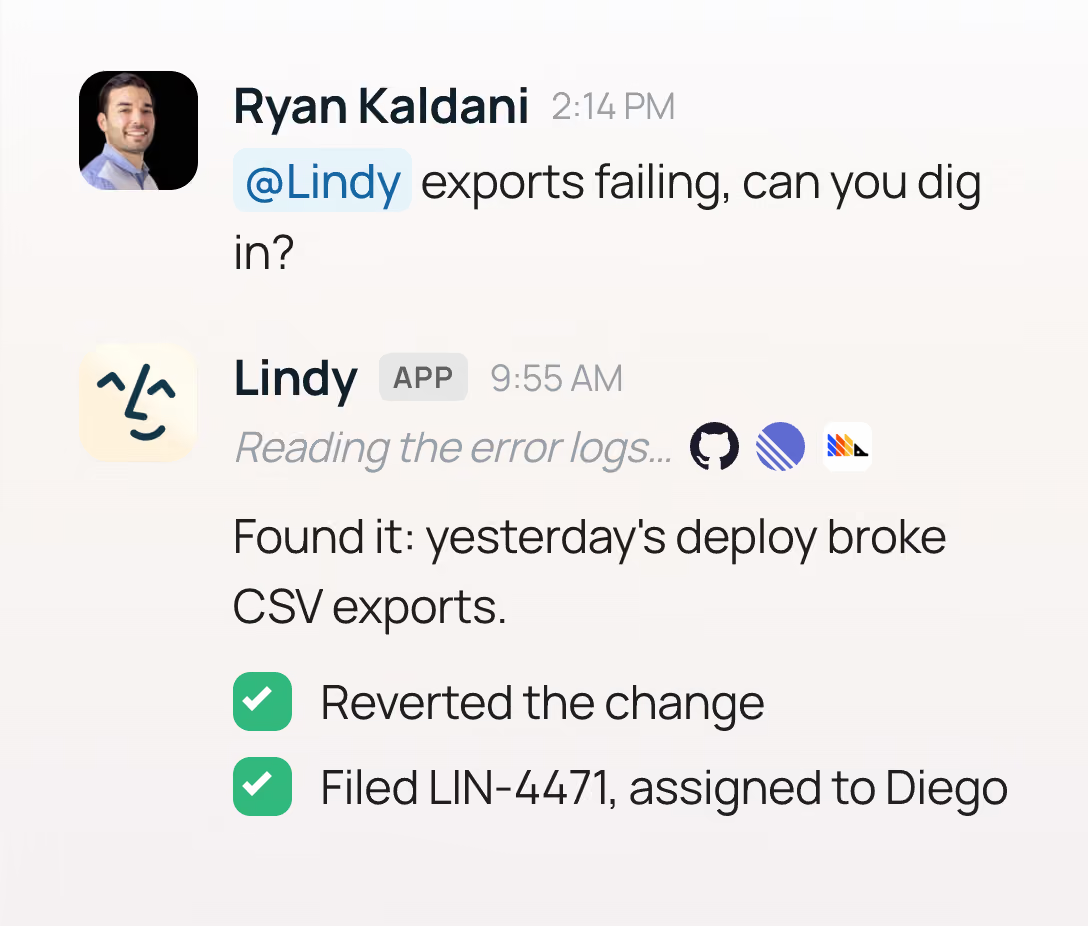
1. Lindy is easier to put to work quickly
Lindy is built around getting a teammate doing normal office work quickly. Email, meetings, call notes, scheduling and Slack are closer to ready-made jobs than blank Agent infrastructure.
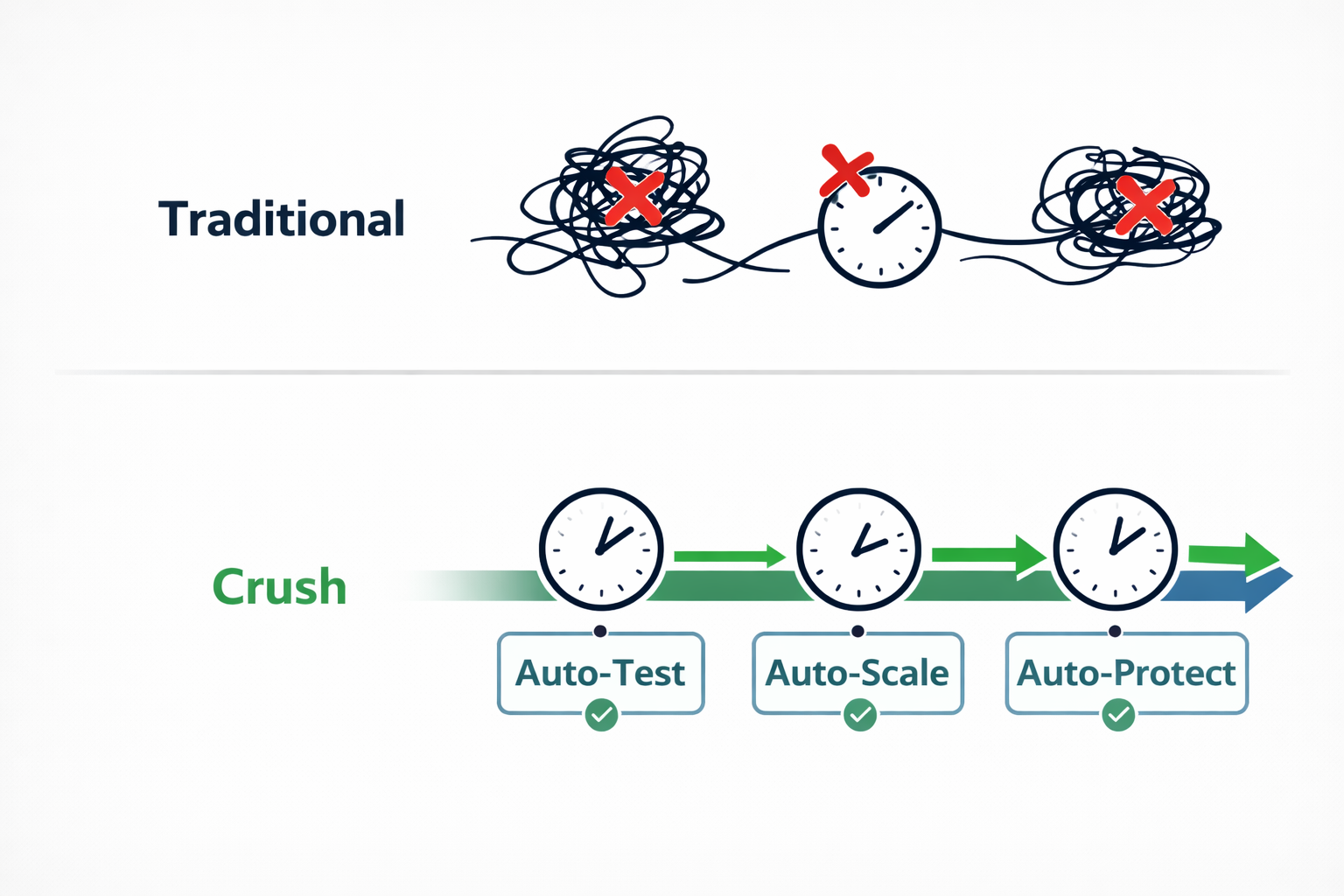
Relevance AI can automate the same categories, but you generally spend more time defining the Agent, its Tools, Knowledge, triggers and approval boundaries.
2. Relevance AI gives you more control over custom Agents
Relevance AI gives the builder clearer control over Prompt, Tools, Knowledge, Triggers, Variables, Memory and more advanced Agent behavior. Invent helps with the first draft, but the finished Agent remains something you can shape deliberately.
That matters when the job is not a standard office assistant pattern and your team needs the Agent to follow company-specific logic.
3. Relevance AI has the clearer visual multi-Agent system
Relevance AI Workforces give several specialist Agents a dedicated visual canvas with Tools, Conditions, optional AI handoffs, mandatory next steps and approval behavior.
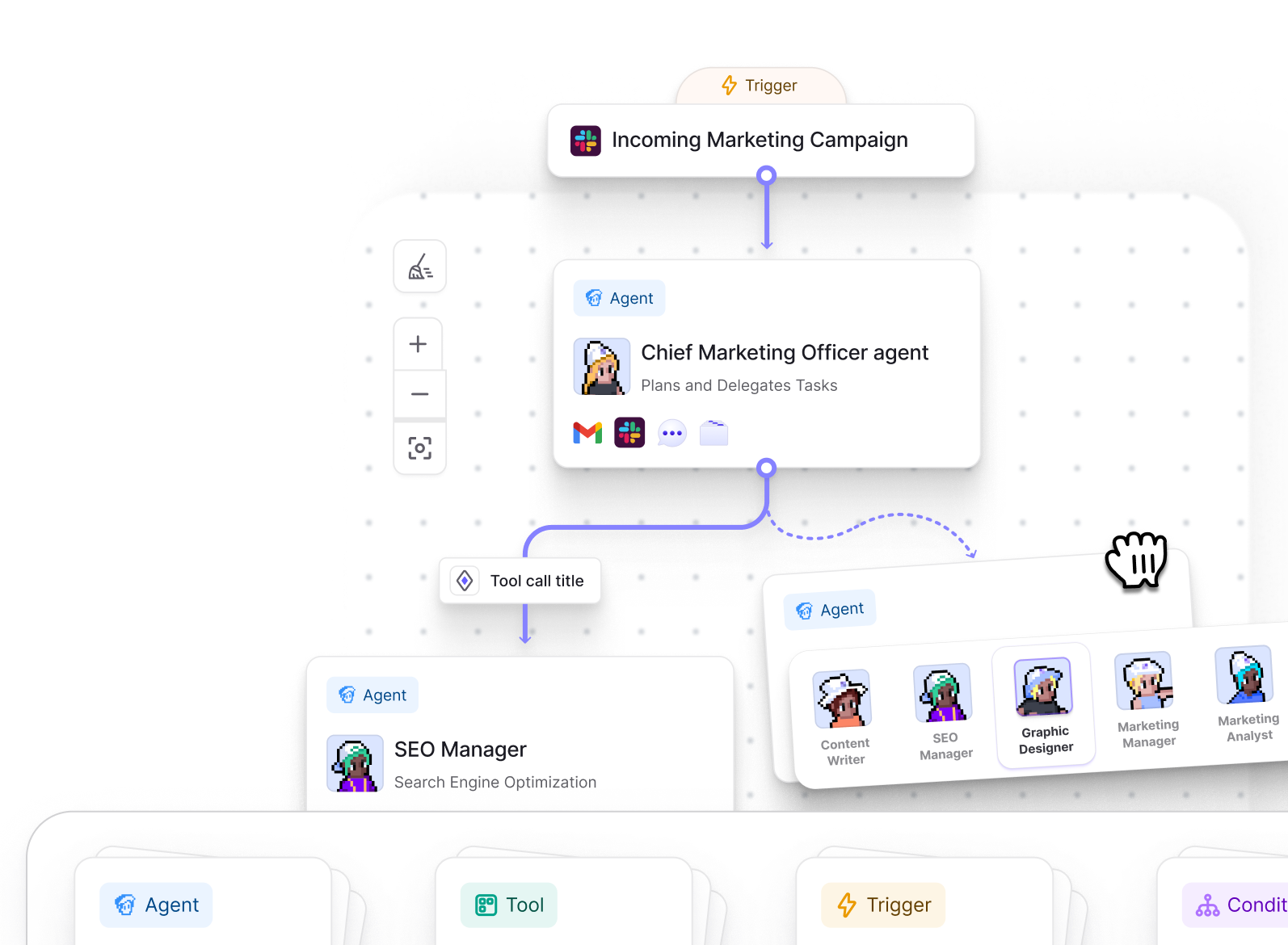
Lindy supports Agent-to-Agent communication and handoffs, but Relevance AI makes the team of Agents easier to inspect as an explicit system.
4. Relevance AI gives you deeper Knowledge and retrieval controls
Relevance AI treats Knowledge as a first-class part of Agent design. It can connect files, websites and business sources, with retrieval behavior that can be tuned when the Agent needs company-specific information.
Lindy can use knowledge and connected information too, but Relevance AI is the stronger choice when retrieval quality is something your team expects to manage deliberately.
5. Relevance AI has more granular approval and escalation controls
Relevance AI lets you put approval behavior around connections and actions so risky work can stop for a person before it reaches an external system.
This is useful when the Agent is allowed to change CRM records, send customer communications or trigger other irreversible actions.
6. Relevance AI has the stronger documented evaluation layer
Relevance AI documents formal Agent and Workforce Evals with reusable checks, simulated scenarios and evaluation workflows. The important limitation is plan access: the current pricing table places Agent Evaluations on Enterprise.
Lindy provides testing, debugging and monitoring, but its public product material does not expose the same formal evaluation framework.
7. Lindy is better for email, meetings and everyday delegation
If your main jobs are meeting capture, follow-up, inbox handling, scheduling and normal teammate requests, Lindy is easier to justify. Those jobs are central to its product experience.
Relevance AI is more flexible, but flexibility is not always valuable when the process you want is already packaged.
8. Relevance AI is cheaper to start building on
Relevance AI has a permanent Free plan with 200 monthly Actions, unlimited Agents and Tools, and one Workforce. Pro is $29/month or $19/month on annual billing.
Lindy can still be better value for a team that immediately replaces several manual office tasks, but Relevance AI gives builders a lower-risk way to prove the platform before paying.
What users say about Relevance AI and Lindy
Relevance AI currently holds a 4.3/5 rating on G2 from 21 reviews. The recurring pattern is positive around no-code Agent building, flexibility, integrations and multi-Agent work, with more mixed feedback around onboarding, admin controls, usage costs and some UI complexity.
- Ease and versatility: several reviewers describe the platform as approachable for custom Agent building once the core concepts click.
- Integrations and customization: reviewers mention APIs, custom Python and multiple connected business tools as meaningful strengths.
- Trade-offs: some users call out onboarding, documentation, governance controls or credit usage as areas that need attention.
“The Best Platform for Creating Custom Agents”
Leopoldo E., G2
Lindy is rated 4.9/5 on G2 from 171 reviews. Reviewers consistently praise ease of use, automation and smooth setup, while heavier users more often mention credit limits, price and learning curves in more complex flows.
“The platform makes it simple to create and customize AI agents for specific business needs”
Naqeeb K., G2
Relevance AI vs Lindy: pros and cons
| Relevance AI | Lindy | |
|---|---|---|
| Pros | • Dedicated custom Agent builder • Visual Workforces • Strong Knowledge model • Formal Evals • Permanent free plan | • Fast office-work setup • Strong email, meetings and scheduling use cases • Excellent G2 sentiment • Slack-first teammate experience |
| Cons | • More setup decisions • Usage model has Actions plus Vendor Credits • Some advanced governance/evaluation features are Enterprise-gated | • Less explicit visual multi-Agent architecture • Heavy usage can make credits/pricing matter quickly • Complex flows still have a learning curve |
Which should you choose?
Choose Relevance AI if…
- You are building custom Agents around company-specific processes.
- You need visual multi-Agent Workforces.
- Knowledge retrieval, approvals and formal evaluation matter.
- You want a permanent free plan to prototype on.
Choose Lindy if…
- Your priority is email, meetings, scheduling and routine office work.
- You want the quickest path to useful teammate behavior.
- Slack is where most delegation already happens.
Related reading
Relevance AI vs Lindy FAQs
Is Relevance AI better than Lindy?
Yes for custom Agent building, multi-Agent orchestration, Knowledge control, approvals and formal evaluation. Lindy is better for fast email, meetings and everyday delegation.
Which is easier to use?
Lindy is easier to get useful office work from quickly. Relevance AI requires more system design but gives you more control.
Which is cheaper to start?
Relevance AI has a permanent Free plan and Pro starts at $29/month or $19/month annually.
Can Lindy build multi-Agent workflows?
Yes. Lindy supports Agent-to-Agent communication and handoffs. Relevance AI wins here because Workforces give multi-Agent orchestration a clearer visual operating model.