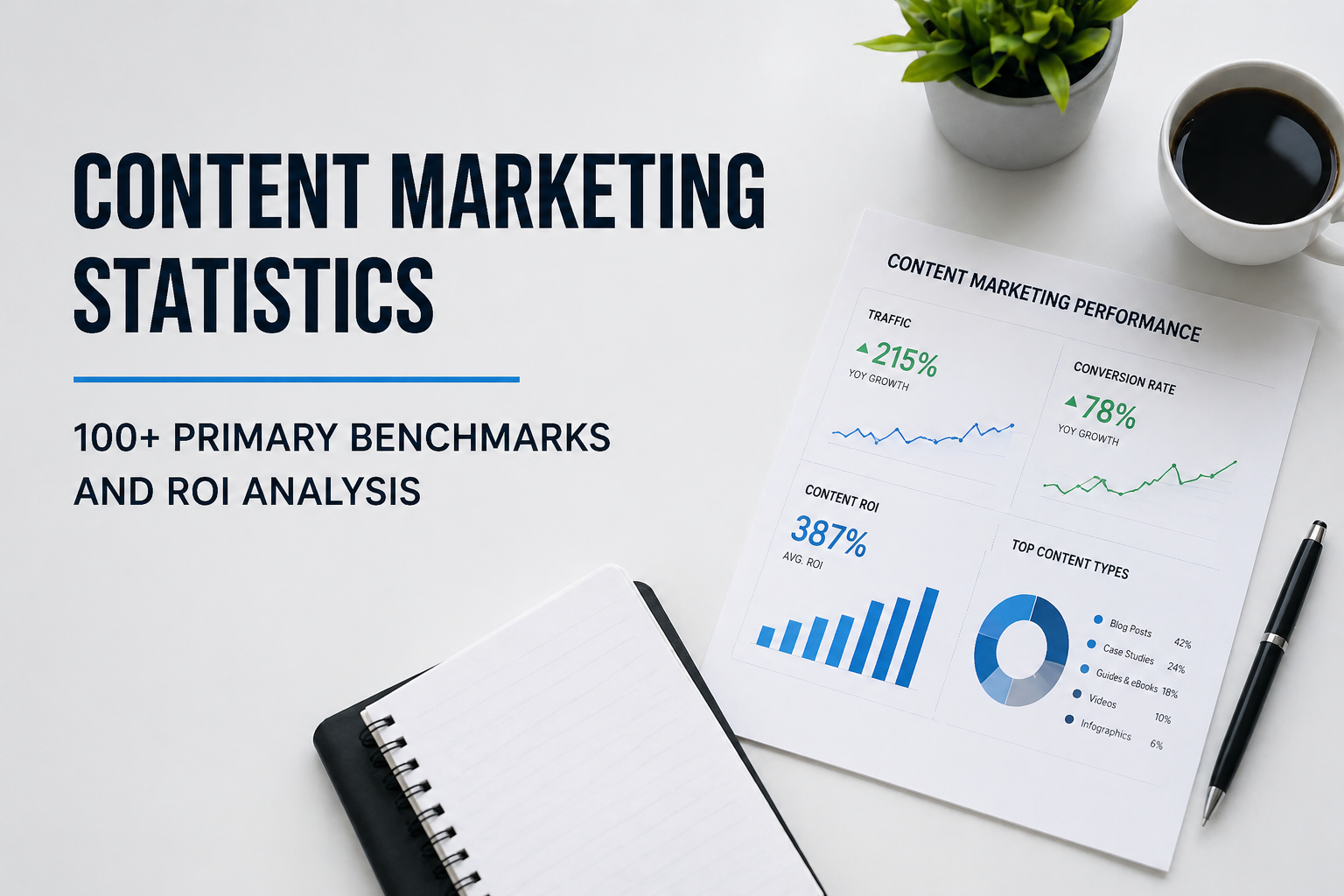
Content Marketing Statistics 2026: 100+ Primary Benchmarks and ROI Analysis
An exhaustive breakdown of the content marketing industry as of April 2026.
The data covers the period from late 2024 through April 2026. Statistics are sourced exclusively from primary research groups: Content Marketing Institute, HubSpot, Gartner, PwC, Wyzowl, and Semrush.
What do these content marketing statistics tell us?
Content Marketing Performance at a Glance
- Content marketing currently pulls in 3x more leads than traditional outbound marketing (CMI, 2026).
- The inference: Outbound is effectively three times less efficient at starting a sales conversation, suggesting that “push” tactics are losing their grip on modern buyers.
- You’ll spend 62.0% less to generate those leads through content than you would through outbound ads (CMI, 2026).
- The inference: Outbound leads aren’t just rarer; they are nearly 2.6 times more expensive.
- SEO delivers an average return of $7 for every $1 invested in B2B organizations (Hubspot 2026).
- The inference: For every dollar spent, you’re getting seven back. This is the highest-returning investment in the B2B playbook.
- 94.0% of marketing teams are now using AI to help create their content (CMI, 2026).
- The inference: AI is no longer a “competitive advantage”—it’s the baseline. If you’re in the 6.0% still doing everything manually, your production costs are likely unsustainable.
- Roughly 81.0% of people are actively ignoring digital ads (Gartner, 2026).
- The inference: Four out of five potential customers have developed a literal “blindness” to your paid placements.
- 91.0% of businesses have made video a core part of their marketing strategy (Wyzowl, 2026).
- The inference: Video has moved from “nice to have” to a non-negotiable standard.
- The wage premium for workers with AI skills has jumped to 56.0% (PwC, 2025).
- The inference: The market is placing a massive financial value on the ability to bridge human creativity with machine efficiency.
- 19.95% of EU enterprises had adopted AI by late 2025 (Eurostat, 2025).
- The inference: Even with the hype, 80% of European firms are still on the sidelines.
- 58.5% of Google searches now end without a click (SparkToro, 2026).
- The inference: You are now competing with Google for your own traffic; brand visibility in results is as important as site visits.
- The global content marketing market is projected to reach $1.95 trillion by 2032 (Statista, 2026).
- The inference: Content is the fundamental engine of the global digital economy.
Related: AI Adoption Statistics 2026
What the numbers say
| Statistic | Value | Scope | Year |
| B2B SEO Average ROI | 748% | Global B2B | 2026 |
| Content vs Outbound Cost | 62% less | Cost per Lead | 2026 |
| AI Adoption in Teams | 94% | Marketing Orgs | 2026 |
| Zero-Click Search Rate | 58.5% | Global Google | 2026 |
| Consumer Ad Avoidance | 81% | U.S. Adults | 2026 |
| Video ROI Success | 87% positive | Global Business | 2026 |
| B2B SaaS Median CAC | $273 | Organic/Paid | 2026 |
| Email Marketing ROI | $42 per $1 | Global | 2026 |
| Average Word Count | 1,333 words | Blog Posts | 2025 |
1. Content Marketing Statistics: ROI and Strategic Budgeting (The “Money” Stats)
The following statistics measure the financial health and allocation patterns of content marketing. In 2026, the Chief Financial Officer (CFO) has moved to the center of marketing strategy, demanding that every dollar spent be tied to a measurable outcome.
- Marketing budgets have stabilized at an average of 7.7% of company revenue (Gartner, 2025).
- The inference: Budgets aren’t shrinking, but they are “flat,” meaning any new technology investment must be carved out of existing spend.
- 59.0% of CMOs say their current budget is insufficient to execute their AI-driven strategy (Gartner, 2025).
- The inference: There is a widening gap between what companies want to do with AI and what they can actually afford to build.
- B2B organizations allocate 20.0% to 30.0% of their total marketing budget specifically to content and thought leadership (Gartner, 2025).
- The inference: Content is now the largest single investment area for B2B brands, surpassing traditional digital advertising.
- Consumer packaged goods (CPG) brands spend 18.09% of revenue on marketing (Gartner, 2025).
- The inference: High-margin retail requires the most constant and expensive brand visibility to survive.
- The Energy sector spends the least, at just 3.21% of revenue (Gartner, 2025).
- The inference: In relationship-led industries, marketing is a supporting function rather than the primary lead engine.
- 72.0% of marketers plan to increase their content budgets in 2026 (HubSpot, 2026).
- The inference: Despite flat overall budgets, companies are reallocating money away from “leaky” channels toward owned content.
- High-performing companies are 28.0% more likely to increase their technology budgets by more than 10% this year (McKinsey, 2026).
- The inference: Growth is now tied to technological infrastructure; those who don’t invest in the stack fall behind the leaders.
- 67.0% of enterprise marketers say they have “proven ROI” from their content programs (CMI, 2026).
- The inference: The majority of large firms can now trace content touchpoints to closed revenue.
- Content marketing generates 6x more conversions than other methods for the same amount of traffic (CMI, 2026).
- The inference: If you have 1,000 visitors from content, you’ll get six times more customers than 1,000 visitors from cold ads.
- 41.0% of marketers now measure content success through direct sales rather than just traffic (HubSpot, 2024).
- The inference: Vanity metrics are dying. If the blog doesn’t sell, it doesn’t get funded.
- Small businesses are 23.0% more likely than the average firm to see ROI from blog posts (HubSpot, 2026).
- The inference: Blogging remains the “great equalizer,” allowing small teams to out-rank massive corporations through specific expertise.
- Companies that lead with organic content see a blended CAC that is 60.0% lower than paid-heavy peers (LTVCACBook, 2026).
- The inference: Building an organic engine is slow, but once it ramps up, it creates a massive competitive price advantage.
- Venture-backed SaaS companies spend 58.0% more on marketing than bootstrapped peers (Whitehat SEO, 2026).
- The inference: Growth at all costs is still the mandate for funded startups, regardless of the industry cooling.
2. The Artificial Intelligence Revolution (Orchestration Benchmarks)
This section tracks the transition from using AI as a writing tool to using it as an “operating system.” The data shows that the volume of content has become a commodity, while human oversight has become the premium.
- AI-assisted workflows have reduced article production time by 75.0% to 85.0% (CMI, 2026).
- The inference: We are no longer limited by typing speed, but by the speed of our thinking and strategy.
- 89.0% of marketers use AI to generate outlines and brainstorming, while only 44.0% use it for full drafts (CMI, 2026).
- The inference: Marketers have learned that full-draft AI output is often too generic to perform, leading to a shift toward “AI-assisted outlines.”
- Content created through a hybrid “AI + human” approach performs 34.0% better on engagement metrics (Semrush, 2026).
- The inference: Readers can smell “average” content. If you don’t add human insight, you’re leaving one-third of your results on the table.
- Raw, unedited AI output typically gets 23.0% less engagement than human-edited versions (Semrush, 2026).
- The inference: Automation without oversight is a recipe for diminishing returns and a damaged brand.
- 67.0% of consumers say they can identify content that was produced entirely by a machine (Edelman, 2026).
- The inference: Authenticity is now a tangible economic asset.
- 80.0% of marketers manually review AI content for accuracy before publishing (Ahrefs, 2025).
- The inference: The “Verify-First” habit is now standard; nobody trusts the machine to be the final word on their brand.
- AI content ranks nearly identically to human content, with 57.0% appearing in the top 10 versus 58.0% for humans (Semrush, 2026).
- The inference: Google doesn’t care if a human wrote it—only if it is helpful.
- According to Content Marketing Institute, 52% of B2B marketers report that agentic AI is improving operational efficiency. (CMI, 2026).
- The inference: The focus is shifting from simple chatbots to autonomous “agents” that can execute multi-step tasks end-to-end.
- 82.0% of executives plan to adopt autonomous AI agents within the next three years (WEF, 2026).
- The inference: We are moving toward a world where marketing teams “direct” a fleet of agents rather than doing the work themselves.
- According to Content Marketing Institute (2026), most B2B marketers are still in the early or “developing” stages of AI implementation, with only about 5% reporting advanced adoption. (CMI, 2026).
- The inference: Most companies are busy setting up the plumbing; the real ROI will happen once they reach the “advanced” stage (only 5% today).
- 61.0% of marketing leaders believe this is the biggest disruption to their industry in 20 years (HubSpot, 2026).
- The inference: This is a fundamental reconfiguration of the profession.
- Workers with AI skills command a 56.0% wage premium (PwC, 2025).
- The inference: The labor market is aggressively rewarding those who can orchestrate technology.
- 38.0% of marketers now use AI specifically for editing and refinement, up from 19% in 2025 (CMI, 2026).
- The inference: We are using AI to make our own writing better, not just to write for us.
3. Search Engine Discovery (Zero-Click & The “Citation” Economy)
Traditional SEO is being swallowed by Generative Engine Optimization (GEO). These stats track how buyers find brands when Google is answering the question directly in the search results.
- AI Overviews appear on 48.0% of all Google queries, reaching 2 billion users. (DigitalApplied, 2026).
- The inference: Half of your potential organic traffic is being “intercepted” by an AI summary.
- Only 8.0% of general searchers click a link when an AI summary is present (Pew Research Center, 2025).
- The inference: Informational “top of funnel” clicks are dying.
- 44.2% of all AI citations come from the first 30.0% of the text (Position Digital, 2026).
- The inference: You have to give your answer immediately. If you bury your conclusion, the AI will never cite you.
- Content with original statistics sees 28.0% to 40.0% higher visibility in AI search results (Averi.ai, 2026).
- The inference: Data is the primary “fuel” for AI search; without it, you are just an opinion.
- 83.0% of top-ranking content now uses “answer blocks” of 40 to 60 words after headings (Averi.ai, 2026).
- The inference: We are formatting our websites to be “AI-friendly,” making it easy for the machine to copy-paste our answers.
- 60.0% of searches now end without a single click to any website (SparkToro, 2026).
- The inference: You must measure “brand impressions” on the search results page, not just traffic to your site.
- Organic search still accounts for 53.0% of all trackable web traffic (BrightEdge, 2026).
- The inference: Despite social and AI, search remains the undisputed king of traffic.
- The #1 position on Google gets a 39.8% click-through rate (InnerSpark, 2026).
- The inference: The difference between position #1 and position #3 is often 3-4x in traffic.
- 85.19% of all blog traffic comes specifically from organic search (Ahrefs, 2025).
- The inference: If your blog isn’t optimized for search, it basically doesn’t exist for 85% of your potential readers.
- Updating old content can boost organic traffic by 106.0% (Semrush, 2026).
- The inference: It is often twice as effective to refresh an old post as it is to write a new one.
- Websites that blog regularly have 434.0% more indexed pages (HubSpot, 2026).
- The inference: More pages = more “hooks” in the water to catch a searcher.
- AI search visitors convert at 4x to 5x the rate of traditional search traffic (Averi.ai, 2026).
- The inference: If someone finds you through ChatGPT or Perplexity, they are much closer to buying than someone just browsing Google.
- There is a “90-day freshness window” for AI discovery; old content is 3x less likely to be quoted (AirOps, 2026).
- The inference: AI models are biased toward “new” news; you have to keep your data fresh to stay cited.
4. Video Content & Interactive Format Performance
Video is the undisputed “king” of formats in 2026. These stats show why teams are shifting over half of their budgets toward multimedia.
- 91.0% of businesses use video as a marketing tool, up from 61% in 2016 (Wyzowl, 2026).
- The inference: In 10 years, video has moved from a “tactic” to a “requirement.”
- 87.0% of video marketers report a positive ROI (Wyzowl, 2026).
- The inference: Nine out of ten companies that do video are making money from it.
- Short-form video (<60 sec) delivers the highest ROI of 49% in 2026 (HubSpot, 2026).
- The inference: Attention spans have crashed; if you can’t say it in 60 seconds, you’re losing the room.
- People remember 95.0% of a message when seen in a video, compared to 10.0% when reading (Wyzowl, 2026).
- The inference: Video is 9.5 times more effective at making a brand name “stick” in a buyer’s mind.
- 96.0% of people have watched an explainer video to learn about a product (Wyzowl, 2026).
- The inference: Almost every buyer now expects a “watch” option before they buy.
- Adding a video to a landing page can boost conversions by 80.0% (HubSpot, 2026).
- The inference: If your landing page doesn’t have a video, you are likely working 1.8x harder to get the same results.
- 85.0% of consumers have been convinced to buy something after watching a brand’s video (Wyzowl, 2026).
- The inference: Video is no longer for “awareness”; it is a closing tool.
- Video emails boost click-through rates by 200.0% to 300.0% (Forrester, 2026).
- The inference: If your email is just text, you’re missing out on a tripling of clicks.
- Interactive content delivers a 52.6% higher engagement rate than static content (CMI, 2026).
- The inference: Quizzes and calculators keep people on your site longer because they provide immediate value.
- YouTube Shorts holds the highest engagement rate (5.91%) of all short-form platforms (Statista, 2026).
- The inference: YouTube is winning the “short-form war” over TikTok for actual engagement.
- 52.0% of content marketers are shifting budgets specifically toward video in 2026 (CMI, 2026).
- The inference: We are seeing a massive migration of capital away from “text-only” teams.
- Average retention for videos under 90 seconds is 53.0%, compared to 10.0% for those over 30 minutes (Wistia, 2026).
- The inference: Long-form video is a niche for deep education; for everything else, 90 seconds is the limit.
Related: AI Productivity Statistics 2026: An Exhaustive Analysis of Time, Output, and Economic Impact
5. B2B and Enterprise Benchmarks
The B2B world is currently facing a “Trust Crisis.” These stats show how buyers are changing and what the biggest firms are doing to stay effective.
- B2B buyers are 69.0% of the way through their journey before they ever talk to a salesperson (Gartner, 2025).
- The inference: Your content is your salesperson for nearly three-quarters of the deal.
- B2B buyers increasingly initiate first contact with sellers, rather than the other way around (Gartner, 2025).
- The inference: Cold outreach is increasingly ineffective; you must be “findable” through content when they are ready.
- 60% of buyers prefer an overall “rep-free” buying experience (Gartner, 2025).
- The inference: If your product requires a demo to understand, you are ignoring 60% of your market.
- Lead generation is the top goal for B2B content marketers. (CMI, 2026).
- The inference: Awareness is nice, but in 2026, content is expected to fill the pipeline.
- 71% of B2B Buyers have consulted a case study before making a purchase (DemandGen, 2026).
- The inference: Case studies are the most influential format in the “decision” stage.
- Enterprise marketers are 2x more likely than small teams to have a “leading” data governance practice (CMI, 2026).
- The inference: Large firms are prioritizing “clean houses” over “more content” to avoid AI legal risks.
- 85.0% of enterprise marketers track “audience engagement” as their top metric (CMI, 2026).
- The inference: For big brands, “time spent with the brand” is the best predictor of future revenue.
- LinkedIn drives 80% of all B2B Social Media Leads. (LinkedIn, 2026).
- The inference: For B2B, spending time on Facebook or Instagram for leads is statistically a waste of time.
- LinkedIn is the #1 most effective platform for B2B content distribution (CMI, 2024).
- The inference: You cannot be absent as a B2B company.
- B2B content marketing cost per lead is $47, compared to $121 for paid ads (HubSpot, 2026).
- The inference: Content leads are 2.5 times cheaper than paid leads.
6. Social Media & Distribution Metrics
Social media has transitioned to a discovery engine. These stats show where people are finding new brands in 2026.
- Social platforms now account for over 60.0% of product discovery, surpassing Google for the first time (Sprout Social, 2026).
- The inference: People go to Google to validate a purchase, but they go to social to find the product.
- 5.66 billion people worldwide now use social media (Statista, 2026).
- The inference: Roughly 64% of the planet is active on these networks.
- The average user hops between 6.75 different networks every month (Sprout Social, 2026).
- The inference: An “omnichannel” strategy is required because your customer is constantly moving.
- 52.0% of Gen Z users trust brand information on social media more than Google search (Sprout Social, 2026).
- The inference: Google is facing a massive “trust crisis” with the younger generation.
- 41.0% of Gen Z turn to social media first when looking for information (Sprout Social, 2026).
- The inference: For young audiences, TikTok is the search engine.
- 94.0% of organizations say influencer marketing outperforms traditional ads (Sprout Social, 2026).
- The inference: Real faces beat corporate logos every time.
- 73.0% of consumers will switch to a competitor if a brand doesn’t respond on social (Sprout Social, 2026).
- The inference: Social is now a critical customer service channel; silence is expensive.
- Total spend on social ads is projected to reach $317 billion in 2026 (Statista, 2026).
- The inference: Despite the annoyance, companies are still pumping massive capital into social feeds.
- 85.0% of people have a profile on Facebook (Sprout Social, 2026).
- The inference: Even if it’s “not cool,” it’s where the mass audience still lives.
- Instagram is used by 70.0% of marketers, making it the most-used platform for brands (HubSpot, 2026).
- The inference: The “visual-first” strategy of Instagram is the current industry standard.
- TikTok was the most downloaded app of 2025 (Statista, 2025).
- The inference: Growth is still concentrated in short-form video.
- 65.0% of users on Bluesky engage with brand content at least once a week (Sprout Social, 2026).
- The inference: Niche platforms offer higher engagement than the saturated giants.
7. Blogging & Content Production Benchmarks
Despite the “death of blogging” rumors, the data shows that written content remains the highest-leverage activity for organic growth.
- The average blog post length is 1,333 words (Orbit Media, 2025).
- The inference: The “war of word count” is over; we are focusing on depth rather than just hitting 2,000 words.
- It takes an average of 3 hours and 46 minutes to write a blog post (Orbit Media, 2025).
- The inference: This is actually 57% more time than it took in 2014, showing that quality requirements have skyrocketed.
- 76.0% of marketers use blogs specifically for lead generation (CMI, 2026).
- The inference: The blog’s primary job has moved from “education” to “acquisition.”
- Companies that publish 16+ posts per month see 3.5x more traffic than those doing 0-4 (HubSpot, 2026).
- The inference: Frequency still correlates with success; volume creates more surface area for discovery.
- 4.4 million new blog posts are published every single day (WordPress, 2026).
- The inference: You aren’t just competing with your rivals alongside a massive wall of noise.
- 83.0% of marketers believe quality trumps quantity, even if it means posting less often (Ahrefs, 2025).
- The inference: One “home run” post is worth more than 10 mediocre ones.
- Articles with a table of contents have 47.0% lower bounce rates (Semrush, 2026).
- The inference: Helping people find what they need immediately keeps them on the page.
- 73.0% of readers admit to skimming blog posts (HubSpot, 2017).
- The inference: Your formatting (H2s, bullets, bold text) is as important as your actual writing.
- “Evergreen” posts make up only 10.0% of total posts but generate 38.0% of all blog traffic (HubSpot, 2026).
- The inference: A small number of posts will do almost all the heavy lifting for your brand.
- 90.0% of marketers agree that “writing and editing” remains the most important skill for success (CMI, 2026).
- The inference: Even with AI, the ability to judge and refine language is still the top skill.
8. Barriers to Value & Organizational Constraints
Not everyone is winning. These stats highlight the specific roadblocks preventing brands from seeing a return on their content.
- 70.89% of companies cite a “lack of expertise” as their #1 barrier to adopting AI (Eurostat, 2025).
- The inference: The bottleneck isn’t the software; it’s the fact that nobody knows how to use it yet.
- 52.0% of people are now taking active steps to block ads, including using VPNs and paying for ad-free tiers (Gartner, 2026).
- The inference: You cannot “buy” your way past this wall; you have to be invited in through helpful content.
- 65.0% of employees are using their own personal AI tools for work (Deloitte, 2026).
- The inference: “Shadow AI” is everywhere. Companies are exposed to massive data risks they don’t even know exist.
- 48.0% of marketers are worried that AI content will damage the trust they have with their audience (Edelman, 2026).
- The inference: If you over-automate, you risk becoming a “faceless” brand that nobody cares about.
- 86.0% of leaders feel their organizations are not prepared to integrate AI into daily operations (McKinsey, 2026).
- The inference: Executives are excited, but the “middle management” level is completely overwhelmed.
- B2B firms are projected to lose $10 billion in 2026 due to poor AI governance (Forrester, 2025).
- The inference: One bad AI hallucination could cost a company its entire quarterly profit in legal fees.
- 52.5% of EU enterprises are holding back on AI due to legal uncertainty (Eurostat, 2025).
- The inference: Regulation (like the EU AI Act) is currently moving faster than adoption.
- Only 35.0% of marketers have a documented strategy (CMI, 2026).
- The inference: Two out of three teams are essentially throwing spaghetti at the wall.
What these statistics suggest heading into 2027
Because 94% of teams have AI, everyone can produce a lot of content. We have reached “Peak Noise.”
Heading into 2027, the new battle is for Trust. The 56.0% wage premium for AI skills and the 90% click-through rate on AI citations both point to the same thing: the market is rewarding people who can be the source of truth.
Eventually, successful brands will stop trying to reach everyone through broad campaigns and focus on niche communities and proprietary data. With 81.0% of people ignoring your ads, your helpful, human-led content is an important connection to the buyer.
Methodology Note
This 2026 edition pulls together official datasets published between late 2024 and April 2026. All figures come from the primary research organizations that conducted the original studies. We have excluded secondary aggregators to ensure every number is verifiable at the source.
Primary Sources
- (https://contentmarketinginstitute.com/b2b-research/b2b-content-marketing-trends-research)
- (https://www.hubspot.com/marketing-statistics)
- (https://www.gartner.com/en/newsroom/press-releases/2026-04-13-gartner-marketing-survey-finds-eighty-one-percent-of-consumers-tune-out-ads)
- (https://ec.europa.eu/eurostat/statistics-explained/index.php?title=Use_of_artificial_intelligence_in_enterprises)
- (https://www.pwc.com/gx/en/services/ai/ai-jobs-barometer.html)
- (https://www.wyzowl.com/video-marketing-statistics/)
- (https://sparktoro.com/blog/google-zero-click-searches-2026-update)
- (https://www.semrush.com/content-hub/can-ai-content-rank-on-google/)

3 Comments
Comments are closed.