While a growing share of organizations now use AI in some capacity, adoption varies sharply depending on industry, company size, and geography.
This 2026 edition compiles the most recent official AI adoption data available, based on surveys and datasets measured during 2024–2025 and published by primary research organizations only, including McKinsey & Company, Eurostat, OECD, UK Office for National Statistics, U.S. Census Bureau, and IBM.
A summary of AI adoption statistics based on available data
Here’s an overview of how widespread AI use has become, and how much room for adoption still exists.
1. 88% of organizations globally reported using AI in at least one business function.
⇒ This implies that around 1 in 8 organizations had not adopted AI at all at the time of the survey.
2. Only about one-third of organizations reported scaling AI beyond pilot projects.
⇒ In other words, most AI users were still experimenting rather than deploying AI at scale.
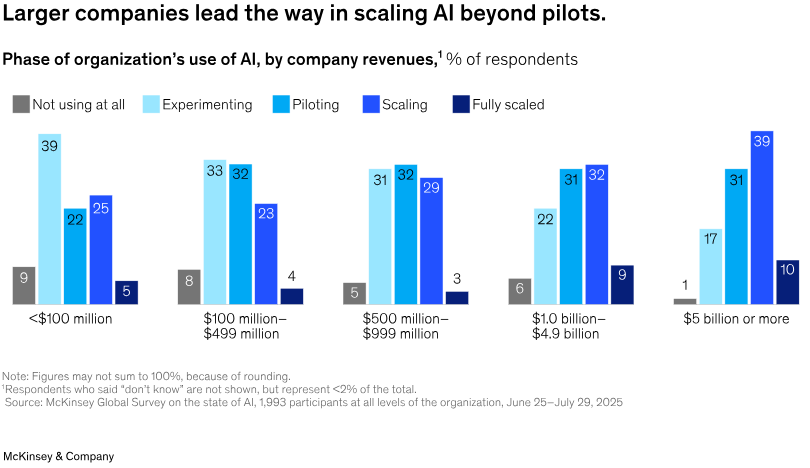
3. Nearly half of companies with revenue above $5B reported scaled AI, compared with 29% of companies under $100M in revenue.
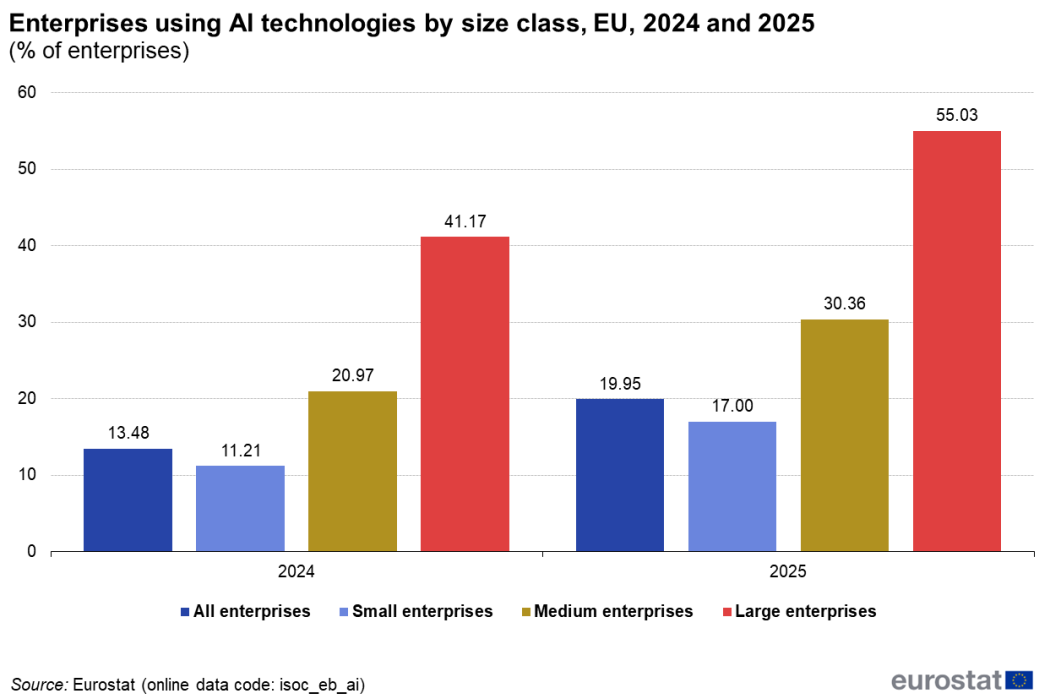
4. 20.0% of EU enterprises used AI in 2025, up from 13.5% in 2024.
⇒ This means roughly four out of five EU enterprises had not yet adopted AI.
5. 55.03% of large EU enterprises (250+ employees) used AI, compared with approximately 17% of small enterprises.
6. 23% of UK businesses reported using AI in late 2025.
7. 42% of large global enterprises had already deployed AI, while 40% were actively experimenting.
#1. AI adoption statistics by industry
AI adoption varies significantly by industry, largely reflecting differences in data availability, digital maturity, and regulatory exposure. Industries built around information processing and knowledge work consistently report higher adoption rates than asset-heavy or manual sectors.
Industry adoption benchmarks (EU)
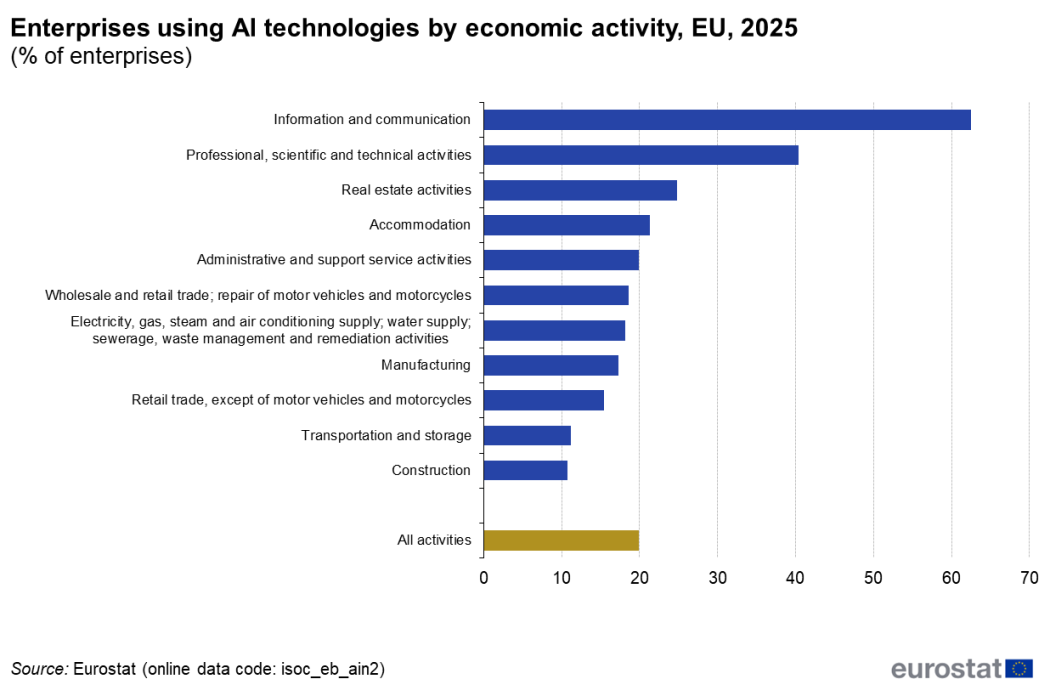
1. 62.52% of enterprises in the information and communication sector used AI in 2025, the highest adoption rate of any industry.
⇒This also means over one-third of firms in this sector had not yet adopted AI, despite its digital nature.
2. 40.43% of professional, scientific, and technical services firms reported AI usage, more than double the EU average.
3. By contrast, only 10.79% of construction firms used AI, indicating that nearly nine in ten firms in the sector had not adopted AI at the time of measurement.
Global industry pattern
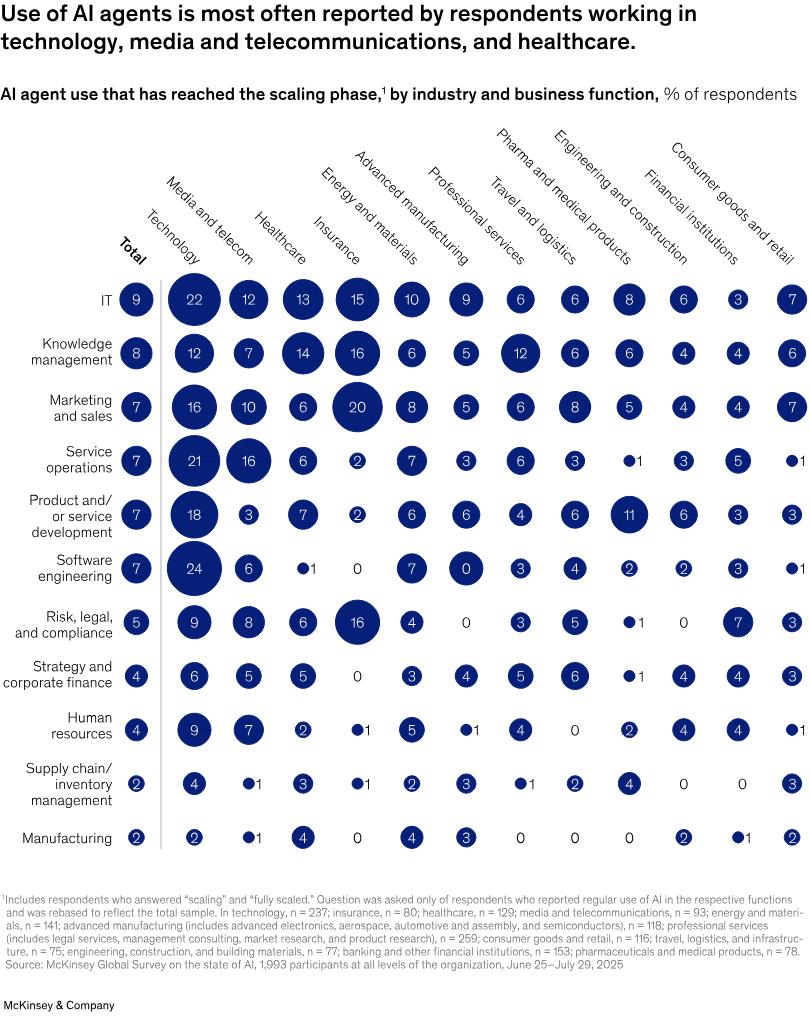
1. Global enterprise surveys show a similar pattern. McKinsey identifies technology, media and telecommunications, and healthcare as industries most likely to report AI use across multiple business functions.
What this tells us
Industries that:
– generate large volumes of digital data,
– rely heavily on analytical or cognitive tasks, and
– face fewer operational constraints
are consistently more likely to adopt AI.
Conversely, industries with fragmented workflows or lower digitization show much slower uptake.
#2. AI adoption statistics by company size
Company size is one of the strongest predictors of AI adoption. Larger organizations tend to have more capital, dedicated data teams, and the governance structures needed to move beyond experimentation. Smaller firms, by contrast, often face tighter budgets, limited expertise, and higher perceived risk.
The statistics below show how sharply AI adoption rates differ between small, medium, and large enterprises.
Adoption rates by company size (European Union)
According to official EU enterprise surveys:
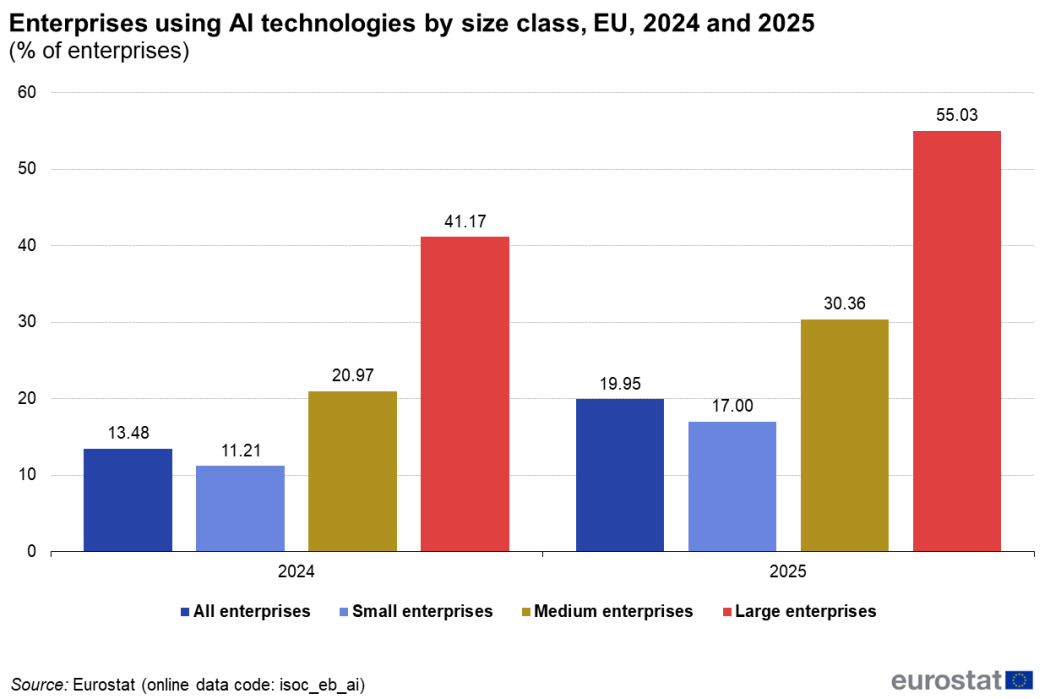
1. 55.03% of large enterprises (250+ employees) used AI in 2025.
⇒This means just under half of large enterprises had not adopted AI at the time of measurement.
2. 30.36% of medium-sized enterprises (50–249 employees) reported using AI.
⇒ In other words, nearly seven in ten medium-sized firms were not using AI.
3. Approximately 17% of small enterprises (10–49 employees) used AI.
⇒ This implies that more than four out of five small firms had not adopted AI.
These figures show a clear, stepwise pattern: AI adoption increases consistently with firm size.
Size and scaling gap (global view)
Beyond adoption alone, company size also affects whether AI is scaled or merely tested.
Global enterprise survey data shows that:
1. Nearly half of companies with annual revenue above $5 billion report having scaled AI, while
2. Only 29% of companies earning under $100 million report the same.
⇒ This indicates that smaller firms are not only less likely to adopt AI, but also far less likely to deploy it at scale once adopted.
Cross-country confirmation (OECD)
OECD research across advanced economies supports this pattern:
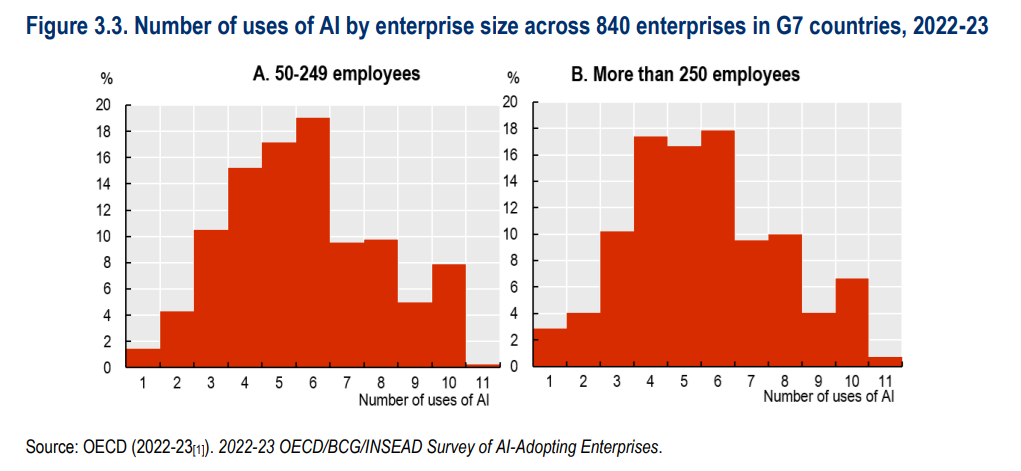
1. Large firms (250+ employees) are roughly twice as likely to adopt AI as medium-sized firms, and several times more likely than small enterprises, particularly when adoption involves core business functions.
What this tells us
The adoption gap by company size is not simply about interest in AI. It reflects differences in:
– access to technical talent,
– data readiness,
– compliance and governance capacity, and
– tolerance for experimentation risk.
As a result, AI adoption in 2026 is likely to continue expanding fastest among large enterprises, while smaller firms adopt more selectively and gradually.
#3. AI adoption statistics by region
AI adoption also varies significantly by geography, shaped by differences in regulatory frameworks, workforce skills, industrial structure, and public-sector support. The statistics below compare adoption rates across Europe, the United Kingdom, the United States, and large global enterprises, based on official surveys conducted between 2024 and 2025.
European Union
Across the European Union:
1. 19.95% of enterprises (with 10 or more employees) used AI in 2025, up from 13.5% in 2024.
⇒ This means around four out of five EU enterprises had not yet adopted AI at the time of measurement.
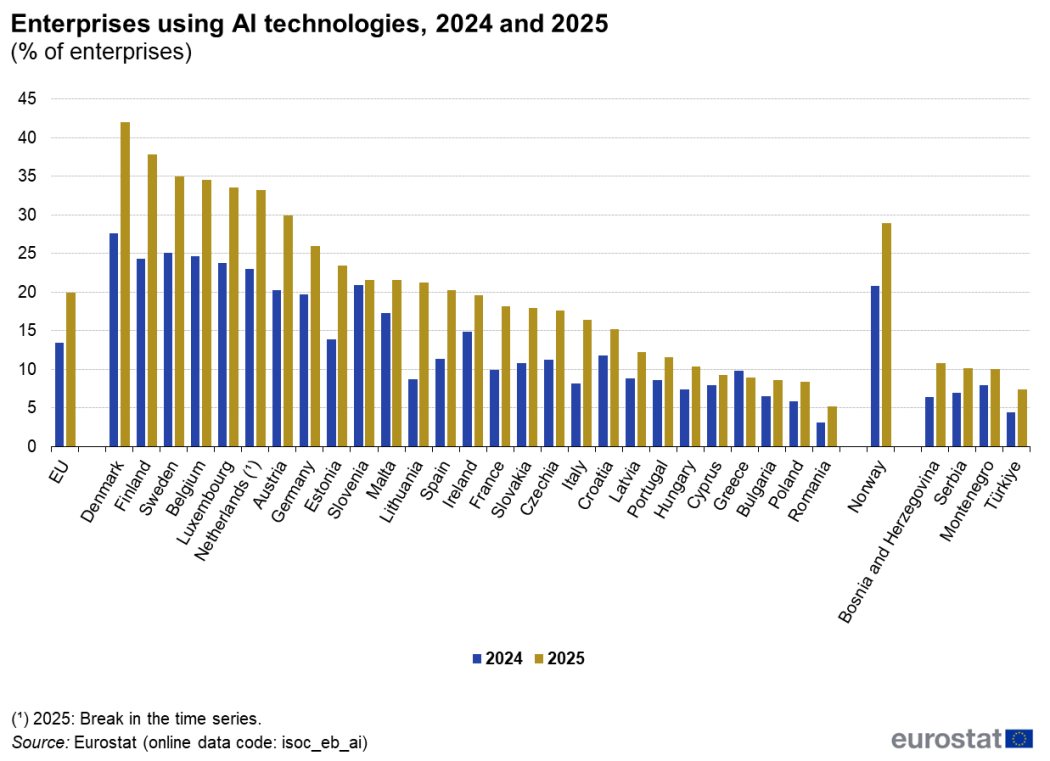
AI adoption within the EU also varies widely by country:
– Denmark: approximately 42.03% of enterprises used AI.
– Romania: approximately 5.21% of enterprises used AI.
This wide range highlights a multi-speed adoption pattern within the EU, rather than a uniform trajectory.
United Kingdom
In the United Kingdom:
1. 23% of UK businesses reported using AI in late 2025.
This places the UK slightly above the EU average, though still far from majority adoption. In practical terms, more than three out of four UK businesses had not adopted AI at the time of the survey.
United States
In the United States, official business surveys conducted by the U.S. Census Bureau show:
1. AI usage is significantly higher among larger firms than among small businesses.
2. Adoption is most common in professional services, finance, and information-related industries, with much lower uptake among smaller and less digitized firms.
While the Census does not publish a single headline adoption percentage comparable to Eurostat, the data consistently show a strong size-based adoption gap, similar to patterns observed in Europe.
Global enterprise perspective
At the global enterprise level:
1. 42% of large organizations (1,000+ employees) have already deployed AI, and
2. 40% are actively experimenting with AI, meaning over four out of five large enterprises are engaged with AI in some capacity.
What this tells us
Regionally, AI adoption tends to be highest where:
– regulatory guidance is clearer,
– digital infrastructure is mature, and
– large enterprises make up a greater share of economic activity.
Conversely, regions with higher concentrations of small firms or lower digital readiness show slower and more uneven adoption.
#4. What businesses use AI for
Adoption alone does not show how deeply AI is embedded in day-to-day operations. In practice, most organizations start with low-risk, decision-support, or front-office use cases, rather than core operational systems.
The statistics below show how enterprises that have already adopted AI are using it, based on official EU enterprise surveys.
AI use cases among enterprises that use AI (European Union)
Among EU enterprises reporting AI use in 2025:
1. 34.70% used AI for marketing or sales activities, such as customer segmentation, personalization, or campaign optimization.
2. 31.05% used AI for business administration or process management, including workflow automation and internal decision support.
3. AI use in research and development and innovation support continued to increase, though at lower levels than marketing and administration.
4. Only 6.08% used AI for logistics or supply-chain–related activities, making it one of the least common use cases.
How to interpret these numbers
These figures indicate that:
1. Most AI adoption today is horizontal rather than deep, supporting existing workflows instead of replacing core systems.
2. Front-office and administrative functions are often the first entry points for AI because they:
– require less integration with legacy infrastructure,
– pose lower operational risk, and
– deliver faster, more visible returns.
At the same time, the low adoption rates in logistics and operational functions suggest that full operational transformation remains limited heading into 2026.
#5. Why AI adoption remains uneven
Despite growing interest in AI, a large share of organizations that have considered adoption ultimately decide not to proceed, at least for now. Official enterprise surveys show that this hesitation is driven less by lack of awareness and more by practical constraints.
The barriers below come from enterprises that explicitly evaluated AI but did not adopt it.
Reported barriers to AI adoption (European Union)
Among EU enterprises that considered AI but did not implement it:
1. 70.89% cited a lack of relevant skills or expertise as a barrier.
⇒ This indicates that skills availability remains the single largest constraint on adoption.
2. 52.52% reported unclear legal or regulatory consequences related to AI use.
3. 48.83% cited data protection and privacy concerns, particularly around compliance and data handling requirements.
4. Cost-related concerns and uncertainty about return on investment were also reported, though less frequently than skills and legal issues.
Structural constraints beyond awareness
These findings are consistent with broader cross-country analysis. Research from the OECD shows that while awareness of AI is high across advanced economies, adoption in core business functions remains limited, particularly among small and medium-sized enterprises.
In many cases:
1. Organizations understand AI’s potential,
2. but lack the internal capacity to deploy it safely or effectively,
3. especially in regulated or operationally complex environments.
What this tells us
The uneven pace of AI adoption is not primarily a question of interest or belief in the technology. Instead, it reflects:
1. shortages in technical and analytical skills,
2. uncertainty around legal and compliance obligations,
3. and difficulty integrating AI into existing systems without disrupting operations.
As a result, AI adoption heading into 2026 is likely to remain selective, with organizations prioritizing lower-risk use cases until these constraints are addressed.
#6. What these statistics suggest heading into 2026
Taken together, the latest official data shows that AI adoption is widespread but uneven, and that the gap between early adopters and lagging organizations remains significant.
Several clear patterns emerge:
1. AI use is common, but the depth of adoption is limited.
⇒ While a large majority of organizations report using AI in some capacity, only a minority have moved beyond experimentation to enterprise-wide deployment.
2. Large enterprises continue to lead adoption and scaling.
⇒ Company size remains one of the strongest predictors of both whether AI is adopted and whether it is deployed at scale.
3. Industry structure matters as much as technology availability.
⇒ Knowledge-intensive, data-rich sectors consistently show higher adoption than asset-heavy or operationally complex industries.
4. Geography shapes adoption through regulation and workforce readiness.
⇒ Regions with clearer regulatory guidance, stronger digital infrastructure, and higher concentrations of large firms report faster adoption.
5. Skills and governance remain the main constraints.
⇒ The most commonly cited barriers to adoption relate to expertise, legal clarity, and data protection rather than lack of interest in AI itself.
Looking ahead to 2026, these patterns suggest that AI adoption will continue to expand, but largely through incremental growth within existing adopter segments, rather than rapid, universal uptake across all firms and industries.
Methodology note
This article is a 2026 edition that compiles the most recent official AI adoption data available at the time of publication. The statistics cited are based on surveys and datasets measured during 2023–2025 and published by primary research organizations.
Definitions of “AI adoption” vary slightly between sources and may include the use of technologies such as machine learning, natural language processing, computer vision, or generative AI systems. Percentages reflect the share of organizations reporting AI use at the time of each survey and should not be interpreted as long-term adoption forecasts.
Primary sources
From:
1. McKinsey – The State of AI
https://www.mckinsey.com/capabilities/quantumblack/our-insights/the-state-of-ai
2. Eurostat – Use of artificial intelligence in enterprises
3. OECD – The Adoption of Artificial Intelligence in Firms
4. OECD – AI adoption by small and medium-sized enterprises
5. UK Office for National Statistics – Business Insights and Conditions Survey
https://www.ons.gov.uk/businessindustryandtrade/business/businessservices
6. IBM – Global AI Adoption Index
7. U.S. Census Bureau – Technology adoption in businesses
https://www.census.gov/library/stories/2025/09/technology-impact.html