Relevance AI vs Gumloop: Which AI Automation Platform Is Better?
Contents
Gumloop wins this comparison 5–4. It is the stronger choice for teams that want agents, reusable deterministic workflows, built-in code execution, self-improving Skills, continuous evaluation, and granular controls over what agents can do in connected apps.
Relevance AI wins when the project depends more heavily on visual multi-Agent orchestration, a larger native integration catalog, configurable Knowledge retrieval, or a permanent free plan.
- Choose Gumloop for agents that need to combine judgment with reusable workflows, code, Skills, and day-to-day self-improvement.
- Choose Relevance AI for visual Workforces with specialist Agents, explicit handoffs, Tools, Conditions, and approvals.
- Choose Gumloop when several employees will build together. Pro currently includes unlimited seats and teams.
- Choose Relevance AI when you want to build and test Agents for free before committing to a subscription.
Relevance AI vs Gumloop at a glance
| Category | Winner and why |
|---|---|
| Building and improving agents | Gumloop. Conversational iteration, Skills, and Reflections make continuous improvement part of the agent workflow. |
| Agents + deterministic workflows | Gumloop. Agents can call complete Gumloop workflows as Tools and can also be embedded inside workflows. |
| Multi-Agent orchestration | Relevance AI. Workforces provide a dedicated visual system for specialist Agents and handoffs. |
| Integrations | Relevance AI. 2,000+ apps versus Gumloop’s current 300+ connector positioning. |
| Knowledge and retrieval | Relevance AI. More explicit controls for how Knowledge is searched and retrieved. |
| Skills, code, and artifacts | Gumloop. Built-in Python/shell sandbox, reusable Skills, and rich generated files are tightly integrated with the agent. |
| Evaluation and improvement | Gumloop. Automated interaction evaluation plus scheduled Reflections create a practical continuous QA loop. |
| Runtime governance | Gumloop. Per-tool approvals and App Rules can govern or block actions before they reach an external system. |
| Starting price and free access | Relevance AI. Permanent Free plan and Pro from $29 monthly or $19 with annual billing. |
Final score: Gumloop 5, Relevance AI 4.
1. Gumloop is easier to improve as you use the agent
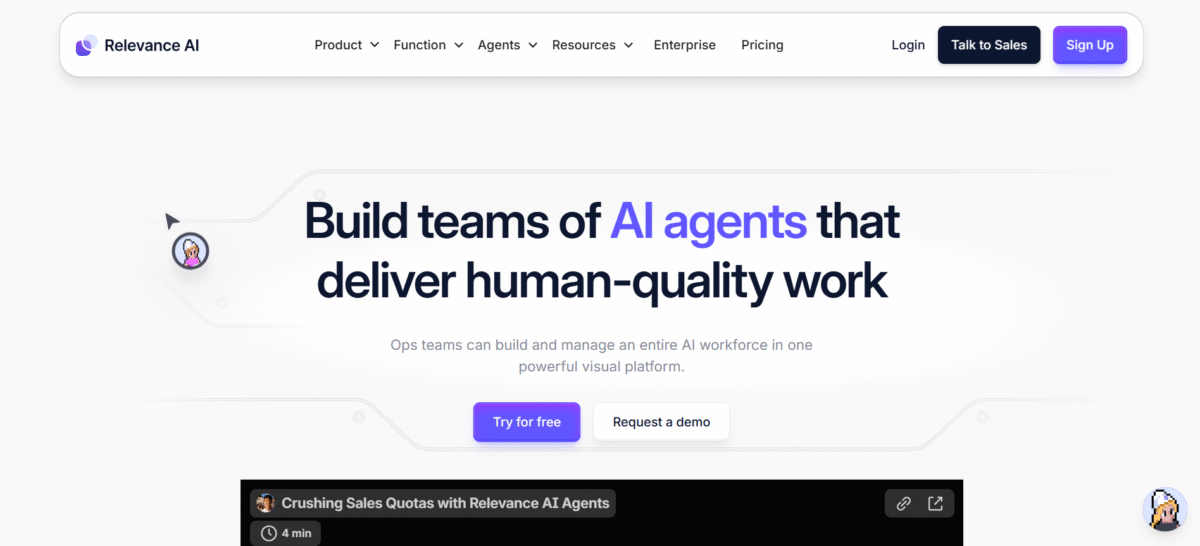
Both platforms let teams create agents without writing the entire system from code.
Relevance AI gives each Agent configurable components such as:
- Prompt;
- Tools;
- Knowledge;
- Triggers;
- Memory;
- Variables;
- and model settings.
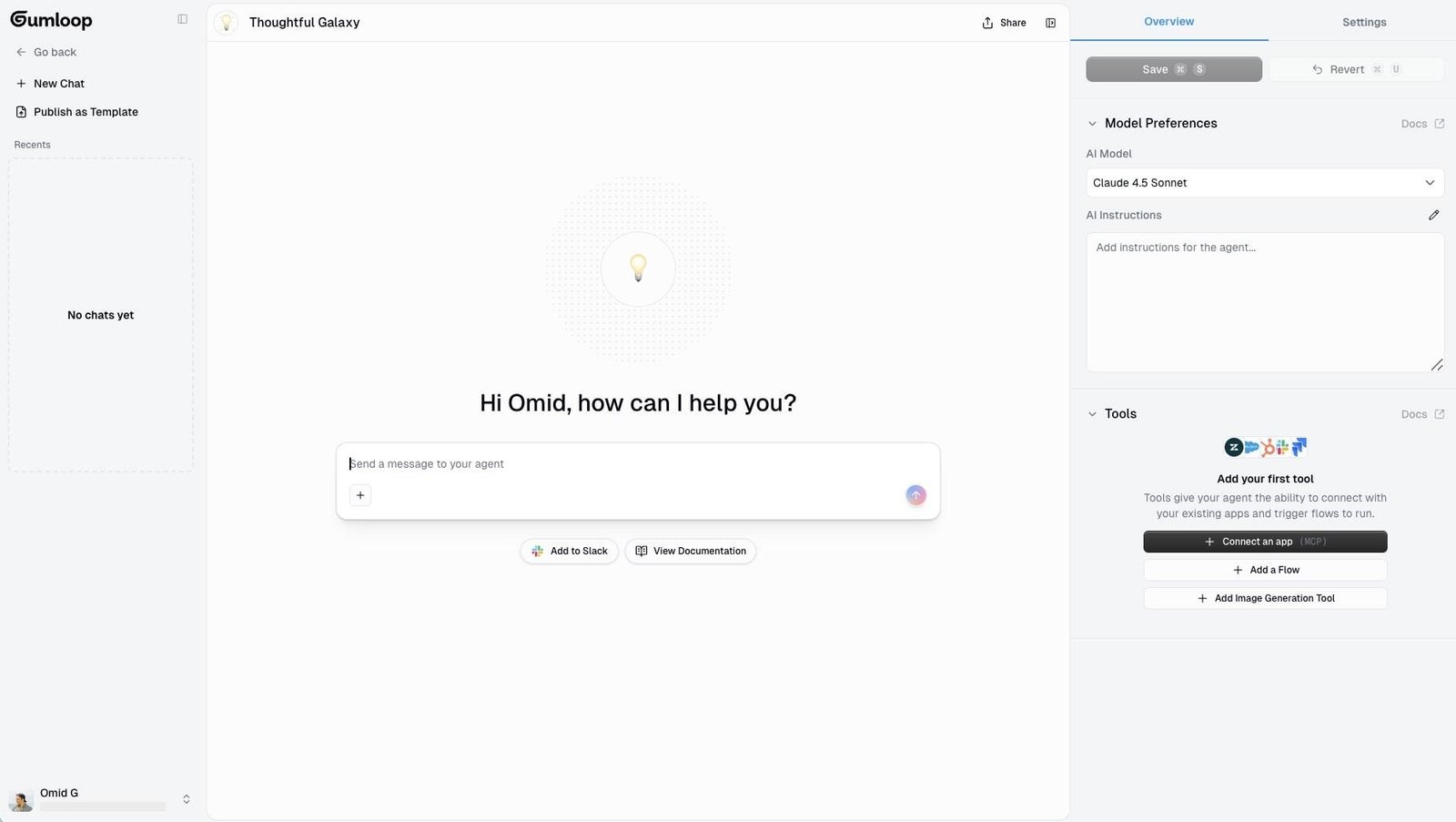
Gumloop’s current agent experience places more emphasis on improving the agent through normal work.
You can:
- give the agent a real task;
- correct its behavior in chat;
- ask it to update its instructions;
- turn a successful process into a reusable Skill;
- and use Reflections to review recent conversations and propose further improvements.
That makes Gumloop particularly appealing when the team expects the agent to improve through repeated use and feedback.
Relevance AI gives builders plenty of configuration control, but Gumloop makes the correction-to-improvement loop more central to the product.
Winner: Gumloop. Running score: Gumloop 1, Relevance AI 0.
2. Gumloop combines agents and deterministic workflows more naturally
Many useful automations contain both judgment and predictable steps.
An agent might decide whether a lead deserves more research. Once that decision is made, a fixed workflow can reliably format fields, enrich the record, and write the result to the correct system.
Gumloop supports that architecture in both directions:
- Workflow as an agent Tool: attach an existing Gumloop workflow to an agent and let the agent decide when to call it.
- Agent inside a workflow: add an Agent node to a Gumloop workflow when only one part of the process needs open-ended reasoning.
This gives teams a straightforward way to keep predictable operations deterministic while giving the agent control over the steps that actually require judgment.
Relevance AI can also build multi-step Tools and place Agents, Tools, Triggers, and Conditions inside Workforces. Gumloop’s workflow system remains a more prominent first-class part of how the product is built.
Winner: Gumloop. Running score: Gumloop 2, Relevance AI 0.
3. Relevance AI has the clearer multi-Agent orchestration system
Gumloop supports multi-agent work through Subagents.
An agent can:
- clone itself for parallel subtasks;
- delegate work to a named specialist agent;
- give that Subagent separate context;
- and receive the result back into the parent conversation.
Relevance AI gives multi-Agent systems a dedicated visual interface through Workforces.
A Workforce can combine:
- specialist Agents;
- Tools;
- Triggers;
- Conditions;
- AI-directed connections;
- mandatory Next Steps;
- and approvals.
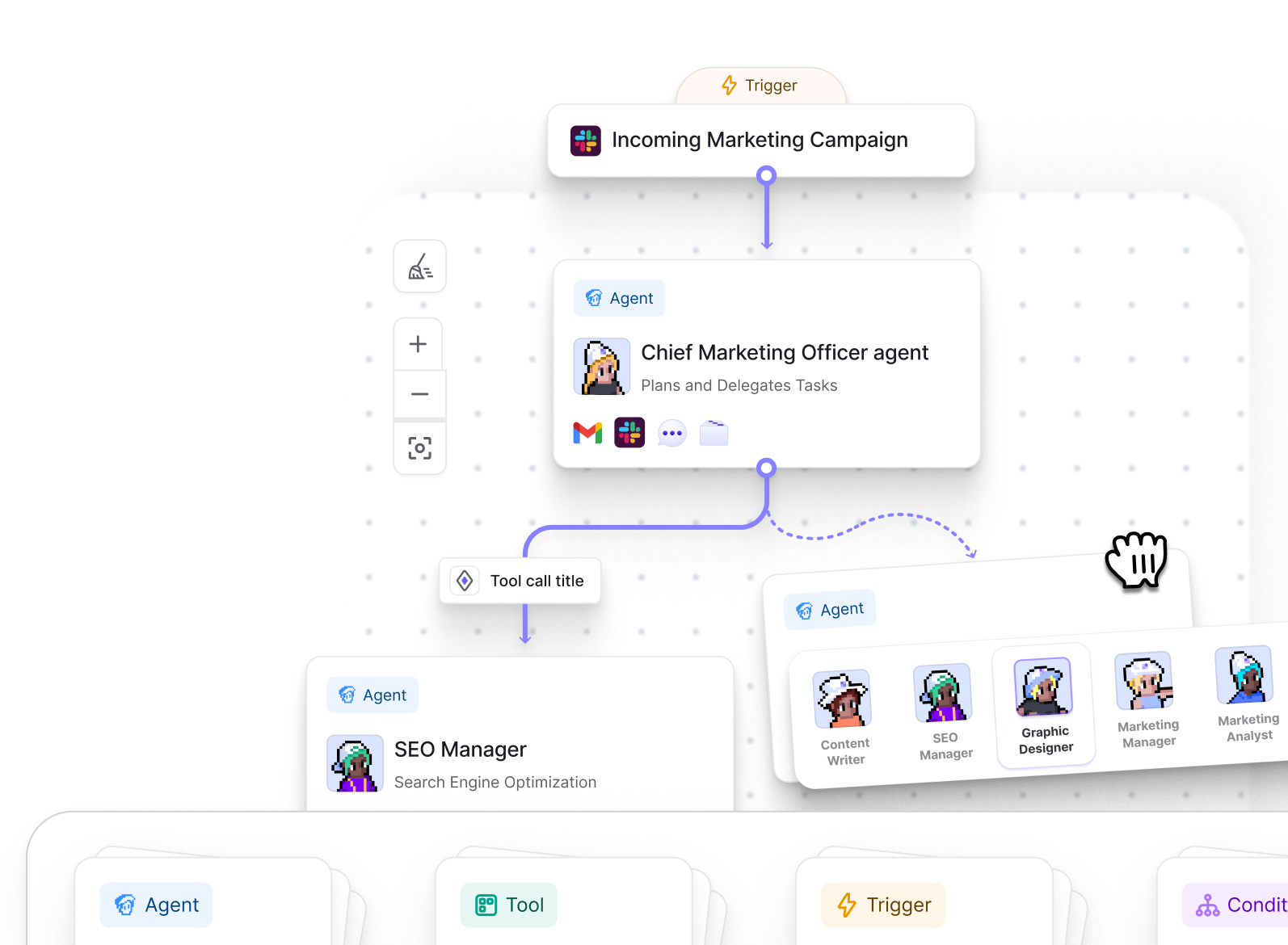
The canvas makes responsibilities and handoffs easier to inspect when a process contains several specialist roles.
Relevance AI’s one-way communication limitation still matters
Current Workforce connections remain one-way.
If Agent A sends work to Agent B, Agent B cannot automatically respond to Agent A through the same connection. Bidirectional communication is not currently supported.
Gumloop’s parent/Subagent model can return a delegated result to the parent, which is useful for some collaborative patterns.
Relevance AI still gets this category because Workforces provide the clearer operating model when the goal is to design and monitor a team of specialist Agents.
Winner: Relevance AI. Running score: Gumloop 2, Relevance AI 1.
4. Relevance AI has the larger integration catalog
Relevance AI’s current pricing documentation lists 2,000+ apps and support for custom apps and API integrations.
Gumloop’s current homepage advertises 300+ connectors.
Gumloop can extend beyond those connectors through:
- hosted MCP servers;
- custom MCP servers;
- workflows;
- and API connections.
The difference therefore matters most when you want a ready-made integration instead of maintaining the connection yourself.
Relevance AI’s larger catalog gives it the advantage for teams working across many business applications.
See our Relevance AI integrations guide for the current ecosystem and practical workflows.
Winner: Relevance AI. Running score: 2–2.
5. Relevance AI gives you more control over Knowledge retrieval
Gumloop’s Company Brain gives agents centralized company context.
Current Brain capabilities include connected company information, retrieval with citations, source scoping, and synced data from business systems. Gumloop has also expanded Brain so knowledge can be synced from additional connectors.
Relevance AI’s Knowledge system gives builders more control over retrieval itself.
Depending on the Tool and setup, you can configure:
- vector search;
- keyword search;
- hybrid retrieval;
- chunking;
- reranking;
- embedding configuration;
- citations;
- and post-processing logic.
Gumloop Brain is appealing when the priority is giving agents access to company information with relatively little retrieval engineering.
Relevance AI is stronger when retrieval behavior itself needs to be tuned.
Winner: Relevance AI. Running score: Relevance AI 3, Gumloop 2.
6. Gumloop agents have a stronger built-in code and Skills layer
Every Gumloop agent currently includes an isolated code sandbox.
The sandbox can:
- run Python;
- run shell commands;
- work with more than 80 preinstalled Python packages;
- generate files;
- analyze data;
- and preserve workspace files and installed packages across conversations.
Gumloop Skills add another layer.
A Skill can contain:
- instructions;
- templates;
- scripts;
- and reusable procedures for a specific job.
Agents can create and improve those Skills as their process becomes clearer.
Gumloop can also produce artifacts such as:
- documents;
- spreadsheets;
- reports;
- code files;
- and interactive outputs.
Relevance AI supports custom Tools, APIs, code-based steps, MCP, and structured outputs too. Gumloop integrates code execution and reusable Skills more directly into the everyday agent experience.
Winner: Gumloop. Running score: 3–3.
7. Gumloop has the better continuous evaluation loop
Both products now have serious Agent evaluation capabilities, but they approach QA differently.
Relevance AI Evals support:
- scenario-based test sets;
- reusable Checks;
- automated scoring;
- individual Agent evaluation;
- complete Workforce evaluation;
- live Monitor dashboards;
- and regression testing before changes are published.
That is the stronger formal pre-deployment testing model.
The current limitation is access. Relevance AI lists Agent Evaluations as an Enterprise feature and says Evals are rolling out progressively beginning with Enterprise customers.
Gumloop Evaluations focus heavily on completed conversations.
They can automatically produce:
- an overall grade;
- pass/fail results against your criteria;
- evaluation rationales;
- sentiment;
- tags;
- and structured data points extracted from the interaction.
Reflections then let the agent periodically review recent conversations and propose improvements to its instructions and Skills.
Relevance AI has the more structured formal test-set system. Gumloop gets this category because evaluation and self-improvement are more tightly connected to the agent’s day-to-day operating loop.
Winner: Gumloop. Running score: Gumloop 4, Relevance AI 3.
8. Gumloop has stronger controls at the moment an agent takes action
Relevance AI supports human approval and escalation inside Workforces. Enterprise adds SSO, RBAC, audit logs, Work Hour Controls, and broader centralized governance.
Gumloop gives builders granular approval settings directly on connected applications and Tools.
Current approval modes include:
- Always allow: let the agent use the Tool automatically.
- Ask each time: require approval for every Tool call.
- Ask for writes/deletes: allow reads automatically while requiring approval for changes.
- Custom: configure approval at individual Tool level.
Gumloop App Rules can add conditional restrictions based on the actual action being attempted.
For example, a rule could:
- block emails to external domains;
- prevent deletion of certain CRM records;
- restrict writes to particular databases;
- or flag specific actions for review.
A blocking rule stops the Tool call before it reaches the connected service.
Pro currently includes Agent-scoped connector policies and guardrails. Enterprise expands governance with organization-wide controls, RBAC, SCIM/SAML, audit logs, model controls, and other administration features.
This runtime policy layer gives Gumloop the edge when Agents are allowed to modify real business systems.
Winner: Gumloop. Running score: Gumloop 5, Relevance AI 3.
9. Relevance AI is cheaper to start
Relevance AI wins the entry-price comparison.
| Platform | Current starting point |
|---|---|
| Relevance AI | Permanent Free plan. Pro is $29/month or $19/month with annual billing. |
| Gumloop | 14-day Pro trial. Pro starts at $37/month. |
Relevance AI Free currently includes:
- 200 Actions per month;
- $2 in one-time Vendor Credits;
- unlimited Agents;
- unlimited Tools;
- one Workforce;
- one user;
- and one project.
Relevance AI Pro includes:
- 2,500 Actions per month;
- $20 in Vendor Credits per month;
- unlimited Workforces;
- two Build Users;
- scheduled tasks;
- premium triggers;
- and bring-your-own LLM support.
Gumloop Pro currently starts at $37 per month and includes:
- unlimited agents;
- 35+ models;
- 20,000 credits per month;
- unlimited seats;
- unlimited teams;
- Company Brain;
- bring-your-own API keys;
- Agent-scoped connector policies and guardrails;
- one hosted MCP server;
- five concurrent workflow runs;
- and 25 concurrent Agent chats.
The usage models are very different
Relevance AI separates usage into:
- Actions for Tool runs;
- Vendor Credits for AI model and eligible Tool costs.
Gumloop’s agent credit cost can include:
- model tokens;
- Tool calls;
- active compute time;
- workflows called by the agent;
- evaluation and self-improvement;
- Subagents;
- and an 8% orchestration fee on applicable usage.
Gumloop currently values one credit at $0.005. Unused Pro credits do not roll over month to month, while Enterprise has rollover.
For Relevance AI, included Vendor Credits roll over while the subscription remains active, base plan Actions reset at renewal, and purchased Action top-ups carry forward.
Measure the same representative workflow in either platform before comparing production cost.
For more detail, see our Relevance AI pricing guide and Actions and Vendor Credits explainer.
You can also see Relevance AI’s current Gumloop comparison or check Gumloop’s current pricing.
Winner: Relevance AI. Final score: Gumloop 5, Relevance AI 4.
Relevance AI vs Gumloop: pros and cons
Choose Gumloop for
- agents that call reusable deterministic workflows;
- built-in Python and shell execution;
- self-improving reusable Skills;
- Evaluations and Reflections;
- granular Tool approval;
- runtime App Rules;
- and unlimited seats on Pro.
Choose Relevance AI for
- visual multi-Agent Workforces;
- a larger app integration catalog;
- deeper Knowledge retrieval controls;
- formal scenario-based Enterprise Evals;
- a permanent Free plan;
- and a lower entry paid price.
Relevance AI vs Gumloop: which should you choose?
Frequently Asked Questions About Relevance AI vs Gumloop
Can Gumloop build multi-agent systems?
Yes. Gumloop agents can delegate to named specialist Subagents or clone themselves for parallel work. The specialist receives its own context and returns its result to the parent agent.
Can Relevance AI Agents communicate with each other?
Yes, through Workforces, but current connections are one-way. A target Agent cannot automatically send information back through the same connection to the source Agent.
Does Gumloop have a free plan?
Gumloop’s current dedicated pricing and credits documentation says new customers receive a 14-day Pro trial rather than a renewable Free plan. Some recent Gumloop blog pages still mention an older Free tier, so use the dedicated pricing page as the current source when signing up.
Can Gumloop agents run code?
Yes. Every current Gumloop agent has an isolated sandbox that can run Python and shell commands. Gumloop says the environment includes more than 80 preinstalled Python packages and can preserve files and installed packages across conversations.
Which platform has more integrations, Relevance AI or Gumloop?
Relevance AI currently advertises more than 2,000 apps, while Gumloop’s current homepage advertises more than 300 connectors. Both can extend their native coverage through APIs, custom connections, and MCP.
Which is cheaper to start, Relevance AI or Gumloop?
Relevance AI is cheaper to start because it has a permanent Free plan. Its Pro plan costs $29 per month or $19 per month with annual billing. Gumloop Pro currently starts at $37 per month after a 14-day trial.